Electricity costs in Aruba rank among the highest in the Caribbean — and for good reason. Island grids face unique pressures: imported fuel dependency, aging infrastructure, and the relentless demand of air conditioning under a near-constant tropical sun. For homeowners and business owners in Oranjestad, those monthly utility bills aren’t just frustrating — they represent a recurring drain on household budgets and business margins.
Here’s the good news: Aruba receives exceptional solar irradiance year-round, making it one of the most promising solar energy environments in the region. But capturing that opportunity starts with one critical step — sizing your solar system correctly. Too small, and you leave savings on the table. Too large, and you’re paying for capacity you’ll never use. Getting it right transforms solar from a good idea into a powerful financial and environmental investment.
This guide walks you through what sizing actually means, what factors matter most in Aruba’s context, and how a professional solar energy assessment in Aruba gives you clarity before you commit a single dollar.
What Does “Sizing a Solar System” Actually Mean?
Solar system sizing is the process of determining how many kilowatts of solar panel capacity — measured in kilowatt-peak (kWp) — your property needs to meet your energy goals. It’s not a one-size-fits-all calculation. Your ideal system size depends on your energy consumption, the physical characteristics of your property, your financial goals, and how you plan to use the energy generated.
At B Energy, we design residential and commercial solar systems ranging from 5 kWp all the way to 100+ kWp, tailored specifically for Caribbean properties. That range exists because a single-family home in Oranjestad has fundamentally different needs than a hotel, restaurant, or commercial warehouse — and every project deserves a solution built around its actual circumstances.
Step 1: Understand Your Energy Consumption
The foundation of any solar system design consultation begins with your energy data. Before recommending a system size, your installer should analyze your electricity bills — ideally 12 months’ worth — to understand your average monthly and daily consumption in kilowatt-hours (kWh).
In Aruba, residential consumption varies significantly. A modest home might use 400–600 kWh per month, while a larger property with multiple air conditioning units, a pool pump, and other appliances could easily exceed 1,500 kWh. Commercial properties vary even more widely depending on operating hours, equipment loads, and building size.
Key consumption factors to evaluate include:
- Air conditioning usage (the single largest energy draw for most Aruba properties)
- Water heating systems
- Lighting and electronics
- Pool or irrigation pumps
- Refrigeration and kitchen equipment (for commercial properties)
- Operating hours and seasonal patterns
Understanding your consumption baseline lets your solar consultant calculate how much energy your system needs to generate on a daily average — which directly translates into the kWp capacity you need installed.
Step 2: Account for Aruba’s Solar Resource
This is where Aruba’s geography becomes your greatest advantage. Aruba sits outside the main hurricane belt and enjoys some of the most consistent solar radiation in the Caribbean, with average peak sun hours ranging between 5.5 and 6.5 hours per day. According to data from the Global Solar Atlas, Aruba’s annual photovoltaic power potential is exceptionally strong, meaning solar panels here generate more energy per kWp installed than in many other global markets.
What this means practically: a properly sized system in Aruba can offset a substantial portion of your electricity consumption — and potentially achieve return on investment within 3 to 5 years, depending on your system size, current tariffs, and energy usage patterns.
However, solar irradiance alone doesn’t determine system output. Your installer must also consider:
- Roof orientation and tilt: South or west-facing roofs in Aruba generally maximize solar capture throughout the day.
- Shading analysis: Nearby trees, buildings, or roof features that cast shadows reduce panel output and must be accounted for in design.
- Available roof or ground space: Physical space limits how many panels can be installed, which sometimes creates a ceiling on system size regardless of energy needs.
- Panel efficiency: Higher-efficiency panels generate more power per square meter — a critical factor when roof space is limited.
Step 3: Know the Right System Size Range for Your Property Type
Residential Solar Panels in the Caribbean
For most homes in Oranjestad, residential solar systems in the 5–15 kWp range cover the bulk of daily household energy needs. A family home with moderate air conditioning use typically falls in the 8–12 kWp range. Properties with higher consumption — larger homes, home offices, or families with electric water heating — may benefit from systems in the 15–25 kWp range.
The goal isn’t necessarily to eliminate your utility bill entirely (grid-connected systems still draw backup power as needed), but to dramatically reduce it while maintaining reliable energy access. Many homeowners see meaningful monthly reductions from day one of system operation.
Commercial Solar Systems
Businesses have even more to gain from solar because they typically consume energy during peak daylight hours — exactly when solar panels are producing at their highest capacity. Commercial solar systems in Aruba typically range from 20 kWp for small retail operations up to 100+ kWp for hotels, warehouses, and larger commercial facilities.
For business owners, sizing should also factor in load management strategy: which operations can shift to daytime hours to maximize self-consumption, and whether battery storage makes sense to extend solar coverage into evening hours.
Off-Grid Considerations
Some properties — remote locations, guesthouses, or facilities seeking complete energy independence — may consider off-grid solar solutions. Off-grid sizing is more complex because it must account for battery storage capacity to cover nighttime and low-production periods, requiring careful balance between panel capacity, battery bank size, and daily consumption patterns.
Step 4: Factor in Coastal and Environmental Conditions
Aruba’s coastal environment brings unique considerations that mainland solar guides simply don’t address. Salt air accelerates corrosion on standard mounting hardware and electrical components. This is why all B Energy installations use marine-grade materials and corrosion-resistant mounting systems designed specifically for island environments.
Panel selection also matters in tropical climates. Modules with strong temperature coefficients perform better under sustained heat, maintaining output efficiency even during Aruba’s hottest months. According to the International Renewable Energy Agency (IRENA), tropical solar installations require careful component selection to ensure long-term performance and durability — a detail that distinguishes experienced Caribbean solar specialists from general installers.
As Caribbean solar energy specialists, B Energy’s team brings this local island expertise to every system design, ensuring your investment is built to last in Aruba’s specific environment — not just adapted from templates designed for other climates.
Step 5: Get a Professional Solar Energy Assessment in Aruba
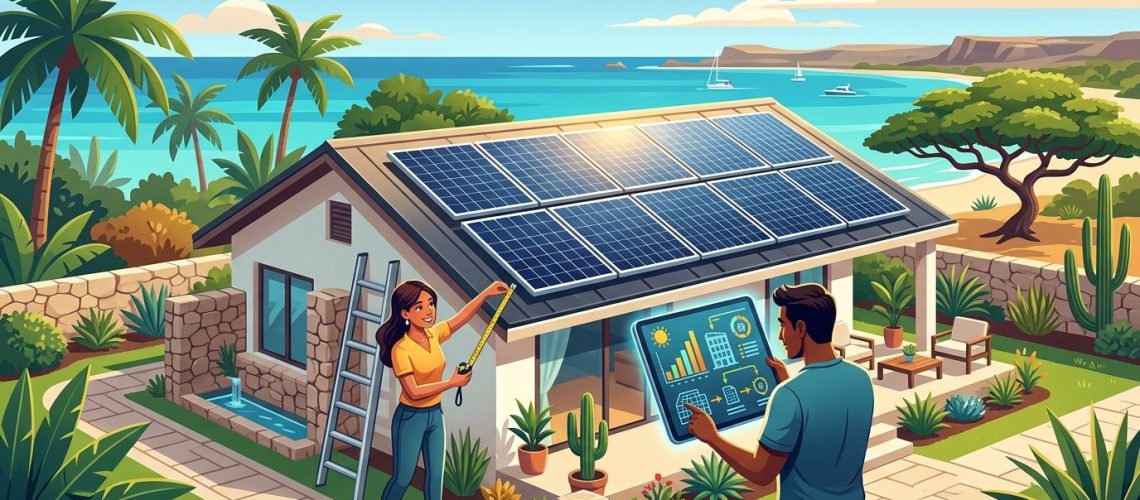
All the general guidance in the world is a starting point — not a substitute for a professional solar energy assessment in Aruba tailored to your specific property. A thorough assessment involves:
- On-site evaluation of your roof or ground mounting area
- Analysis of your electricity bills and consumption patterns
- Shading and orientation measurements
- Review of your energy goals (maximum savings, energy independence, environmental impact)
- Financial modeling showing estimated payback period and long-term savings
- A custom system design with specific panel count, inverter sizing, and layout
This is where solar consultation services become genuinely valuable. A well-designed solar system isn’t just about the panels on your roof — it’s about the complete energy picture of your property, your lifestyle or business operations, and your financial objectives. Getting the sizing right from the start means your system performs as expected from day one.
Frequently Asked Questions
How many solar panels does a typical Aruba home need?
Most residential properties in Oranjestad require between 15 and 35 panels depending on energy consumption and panel efficiency. A home using 800 kWh per month typically needs a system in the 8–12 kWp range, which translates to approximately 18–28 panels using standard 400–450W modules.
Can I add more panels later if my needs grow?
Yes, most grid-connected solar systems can be expanded over time, provided your inverter has capacity for additional input and your roof has available space. This is an important design consideration to raise during your solar system design consultation — building in scalability from the start avoids costly redesigns later.
Does shading really affect solar output that much?
Shading has a significant impact on solar production, particularly in older string inverter configurations where shading on one panel can reduce output across an entire string. Modern microinverters or power optimizers mitigate this issue by allowing each panel to operate independently — an important technology choice for properties with partial shading.
Is solar a good investment for small businesses in Aruba?
Absolutely. Small and medium-sized businesses in Oranjestad often see some of the strongest solar ROI because their daytime energy consumption aligns directly with peak solar production hours. Commercial systems in the 20–50 kWp range can deliver meaningful reductions in operating costs, with payback periods typically in the 3–5 year range depending on current tariffs and usage patterns.
What’s the difference between grid-tied and off-grid solar systems?
Grid-tied systems remain connected to the utility grid and allow you to draw backup power when solar production is insufficient (such as at night). Off-grid systems operate independently using battery storage to cover all energy needs. Most Aruba homeowners and businesses benefit from grid-tied systems, which offer lower upfront costs and reliable energy backup without requiring large battery banks.
Your Path to Energy Independence Starts Here
Sizing a solar system correctly is the difference between a good solar experience and a transformative one. It’s the foundation on which lower electricity bills, long-term energy security, and a meaningful contribution to Aruba’s sustainable future are built.
At B Energy, our community-focused solar solutions are designed from the ground up for island properties — with local expertise, proven Caribbean-specific knowledge, and a genuine commitment to helping Oranjestad residents and businesses thrive. We believe solar isn’t just a technology upgrade; it’s a step toward a more resilient, empowered community for everyone on this island.
Ready to find out exactly what size system your property needs? Contact B Energy today to schedule your professional solar energy assessment in Aruba — and take the first confident step toward energy independence.