Electricity bills in Aruba consistently rank among the highest in the Caribbean. For many families and business owners in Oranjestad, that monthly invoice has become a source of real stress—and a growing motivator to take control. Solar energy offers a genuine path forward, but one question tends to stop people before they even get started: Should I stay connected to the grid, or go completely off on my own?
It’s one of the most important decisions you’ll make in your solar journey, and the right answer depends on your lifestyle, your goals, and how much energy independence you’re after. This guide walks you through both options clearly, so you can move forward with confidence.
Understanding Your Two Main Solar Paths
At the heart of every home solar installation in Aruba is a fundamental choice: grid-tie or off-grid. These aren’t just technical categories—they represent two different relationships with energy, each with its own advantages and trade-offs.
What Is a Grid-Tie Solar System?
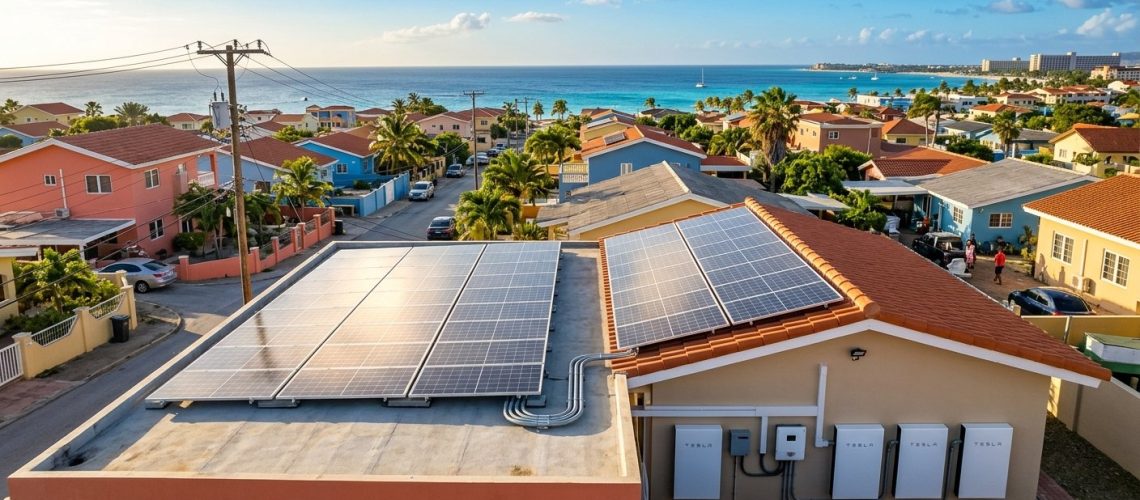
A grid-tie system connects your solar panels directly to WEB Aruba’s public electricity network. Your panels generate power during daylight hours, you use what you need, and any surplus flows back to the grid. When the sun sets or demand exceeds your production, you draw power from the grid as usual.
Many grid-tie setups today also include battery storage—sometimes called grid-tie battery systems—which store excess solar energy so you can use it in the evening or during brief outages. This hybrid approach has become increasingly popular among Aruba homeowners who want meaningful energy independence without cutting the cord entirely.
Key advantages of grid-tie solar:
- Lower upfront installation cost compared to full off-grid systems
- Continuous power availability through the grid as a backup
- Potential to offset electricity bills substantially over time
- Simpler system management for most households
- Scalable—add battery storage later as your budget allows
What Is an Off-Grid Solar System?
An off-grid solar system operates entirely independently from the public utility network. Your home is powered exclusively by your panels and a robust battery bank that stores energy for use around the clock. There’s no utility connection—and no utility bill.
For Aruba homeowners in more remote locations, or for those who prioritize complete energy autonomy, off-grid solar solutions offer a powerful sense of freedom. That said, going fully off-grid requires careful system design to ensure your battery capacity and solar array can handle your home’s total energy needs—including cloudy days and higher-consumption periods.
Key advantages of off-grid solar:
- Complete independence from the utility grid and its pricing
- Ideal for properties where grid connection is unavailable or expensive to establish
- Long-term elimination of monthly electricity charges
- Maximum energy security and self-sufficiency
Aruba’s Unique Solar Advantage
Here’s something worth appreciating: Aruba is exceptionally well-suited for solar energy. The island receives abundant sunshine year-round, with consistent solar irradiance that makes panel performance highly predictable. Unlike many locations, Aruba’s stable tropical climate means your system can generate reliable energy output across all seasons.
According to the International Renewable Energy Agency (IRENA), Caribbean islands like Aruba have some of the strongest solar resource profiles in the world, with potential to dramatically reduce fossil fuel dependency through smart solar adoption. That potential is sitting right above your rooftop every single day.
Aruba also benefits from steady trade winds that naturally cool solar panels, helping them operate at higher efficiency levels than panels in hotter, more humid island environments. For Caribbean home solar systems, this is a meaningful performance advantage.
Comparing the Real Costs
Let’s talk honestly about solar panels cost in Aruba—because this is where many homeowners start to hesitate, and where clarity matters most.
Grid-Tie System Investment
For a typical Aruba home, a grid-tie residential solar system in the 5–15 kWp range represents a meaningful but manageable investment. The payback period for most homeowners falls in the 3–5 year range, after which the system generates financial returns for its remaining 20+ year lifespan. That’s a compelling residential solar ROI in Caribbean terms—especially compared to the alternative of paying rising utility rates indefinitely.
Adding a battery system increases upfront cost but dramatically improves energy security and reduces grid dependence, making it the choice for homeowners who want the best of both worlds.
Off-Grid System Investment
Solar off-grid systems in Aruba require a larger initial investment because they must account for 100% of your energy needs. Battery storage, charge controllers, and system redundancy all add to the cost. However, for properties without existing grid connections—or for homeowners committed to full independence—the long-term financial and lifestyle rewards can be substantial.
The key with off-grid solar design is accurate sizing. Undersizing your battery bank or panel array creates energy shortfalls. Oversizing adds unnecessary cost. Getting this right requires local expertise and a detailed energy audit of your home’s actual consumption patterns.
Which System Is Right for Your Aruba Home?
There’s no universal right answer—but there are clear indicators that point you toward one option or the other.
Grid-tie is likely the better fit if you:
- Already have a reliable utility connection and want to reduce (not eliminate) your bills
- Are optimizing for the fastest return on investment
- Want a simpler system with less day-to-day management
- Plan to scale up gradually, adding batteries over time
Off-grid may be your best path if you:
- Live in a location where grid connection is unavailable or prohibitively expensive
- Prioritize complete energy independence above all else
- Want to eliminate your electricity bill entirely over the long term
- Are building a new property and prefer to design energy systems from scratch
For business owners considering commercial solar solutions, the calculation also involves operational continuity, tax considerations, and larger system sizing—typically 30–100+ kWp. The right configuration can transform energy from a cost center into a competitive advantage.
Coastal Installation Considerations
Living on an island means your solar system needs to be designed for a coastal environment. Salt air, humidity, and UV exposure are real factors that affect equipment longevity. This is why choosing components rated for marine environments—and working with Caribbean solar energy specialists who understand these conditions—makes a significant difference in long-term system performance.
Quality mounting systems, corrosion-resistant hardware, and panels tested for coastal climates aren’t optional extras in Aruba. They’re the baseline standard for any installation that will perform reliably for 25 years or more. The National Renewable Energy Laboratory (NREL) has documented how environmental factors like salt exposure can affect panel performance, reinforcing the importance of proper equipment selection and installation practices in island settings.
The Community Dimension of Going Solar
Choosing solar in Aruba isn’t just a personal financial decision—it’s a contribution to something larger. Every home that generates its own clean energy reduces pressure on the island’s fossil fuel-dependent grid. As more households and businesses make this shift, Aruba moves closer to the energy-independent future its people deserve.
This is the vision that drives B Energy’s work in Oranjestad. As a community-focused solar solutions provider rooted in the Caribbean, we see each installation as one more step toward an island that powers itself—cleanly, reliably, and sustainably. Explore our residential solar systems to see how we design solutions tailored specifically for Aruba homes.
Frequently Asked Questions
Can I add battery storage to a grid-tie system later?
Yes. Many Aruba homeowners start with a basic grid-tie system and add battery storage as their budget allows. This staged approach lets you begin benefiting from solar immediately while building toward greater energy independence over time. It’s important to ensure your initial installation is designed to accommodate batteries from the start.
How large a solar system does a typical Aruba home need?
Most residential properties in Oranjestad work well with systems between 5 and 15 kWp, depending on household size and energy consumption. A thorough energy audit—reviewing your actual electricity bills and usage patterns—is the essential first step to accurate system sizing.
What happens during a power outage with a grid-tie system?
A standard grid-tie system without batteries will shut down during a grid outage for safety reasons. However, a grid-tie system with battery backup can continue powering your home during outages by switching to stored energy—giving you both grid connectivity and meaningful resilience.
Is off-grid solar reliable enough for full-time living in Aruba?
When properly designed and sized, off-grid solar systems in Aruba are highly reliable. The island’s consistent sunshine makes it an excellent environment for off-grid living. Proper battery capacity, panel sizing, and system monitoring are the keys to uninterrupted performance.
What is the typical ROI timeline for residential solar in the Caribbean?
Most homeowners in Aruba see a return on investment within 3 to 5 years, depending on system size, energy consumption, and installation specifics. After payback, the system continues generating value for 20+ years—representing a significant long-term financial benefit.
Ready to Take the Next Step?
Whether grid-tie or off-grid is the right fit for your home, the most important move you can make today is starting the conversation. B Energy’s team of local island experts is here to help Oranjestad homeowners and business owners navigate every option—from initial energy audit to final installation—with the care and transparency your community deserves.
Your energy future is closer than you think. Contact B Energy today for a personalized solar assessment, and let’s design a system that works for your home, your budget, and your vision of a more sustainable Aruba.