
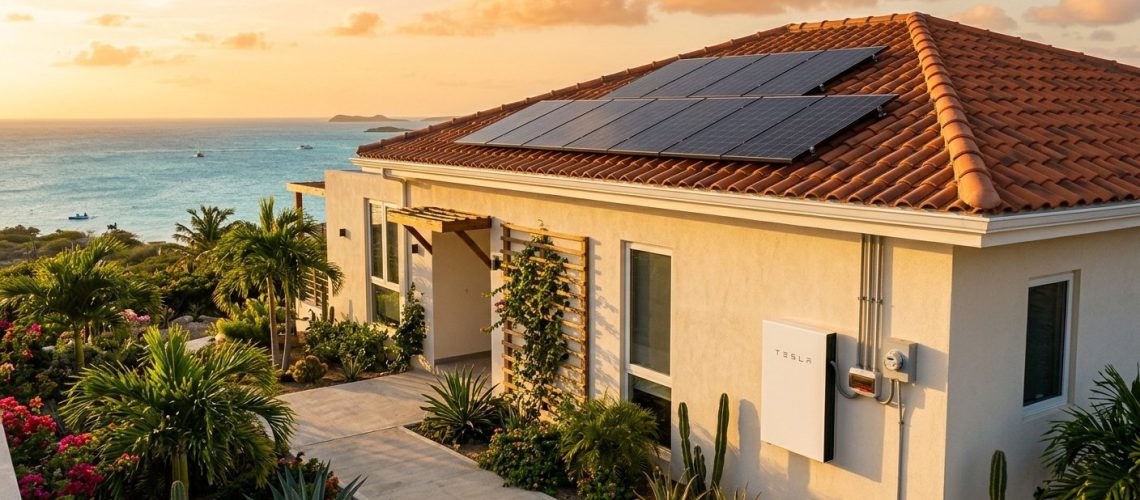
Solar battery storage lets Caribbean homeowners and businesses pair their solar panels with a rechargeable battery bank, so the clean energy generated during the day is available at night or during grid outages. For households in Aruba dealing with high electricity tariffs and occasional grid interruptions, adding battery backup to a solar system is one of the most practical steps toward genuine energy independence.
- Battery storage captures surplus solar energy and makes it available when the sun isn’t shining—cutting reliance on the utility grid.
- Lithium iron phosphate (LFP) batteries are the current standard for tropical climates: longer lifespan, safer chemistry, and better heat tolerance.
- A properly sized solar-plus-storage system in Aruba typically delivers a 3–5 year payback, based on local electricity costs.
- Coastal environments require corrosion-resistant enclosures and careful siting—local expertise matters enormously.
- Battery storage works for homes and businesses alike, from compact residential units to large commercial arrays of 100+ kWp.
Why Battery Storage Changes the Equation in Aruba
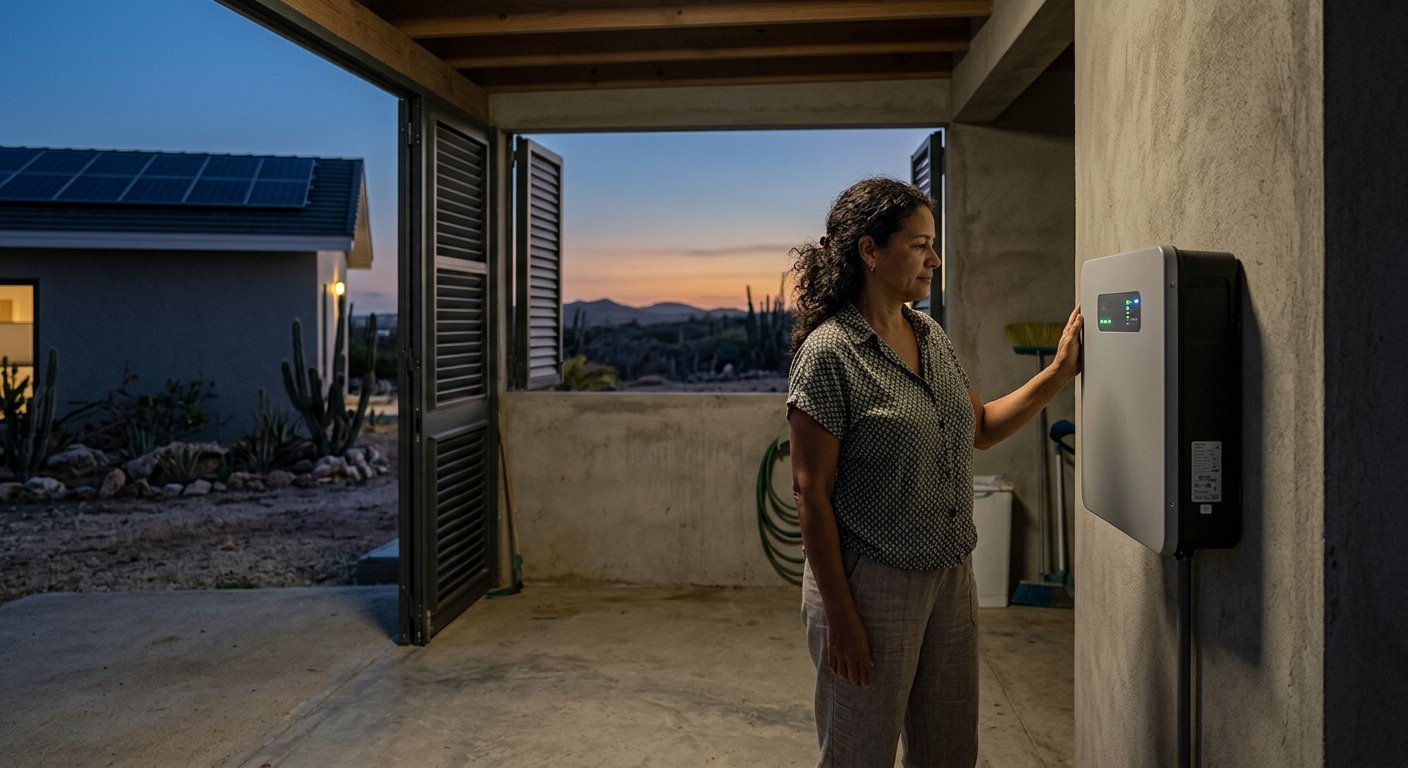
Electricity in Aruba is among the most expensive in the Caribbean, driven by the cost of importing fossil fuels to run conventional power generation. Every kilowatt-hour your solar system generates and stores is one you don’t buy from the grid. Without storage, excess solar production is either exported (sometimes at a low credit rate) or simply wasted. With a battery, that energy stays in your home or business, working for you around the clock.
There’s a common misconception that batteries are only useful during power outages. In reality, the daily financial benefit—shifting stored solar energy to the evening hours when your household demand peaks—is often where homeowners see the most immediate impact on their utility bills. Think of it as your own personal energy reserve, refilled every sunny day at zero fuel cost.
A battery transforms solar from a daytime resource into an all-day energy solution—and in Aruba’s sunshine, that battery refills itself every single day.
How Solar Battery Storage Actually Works
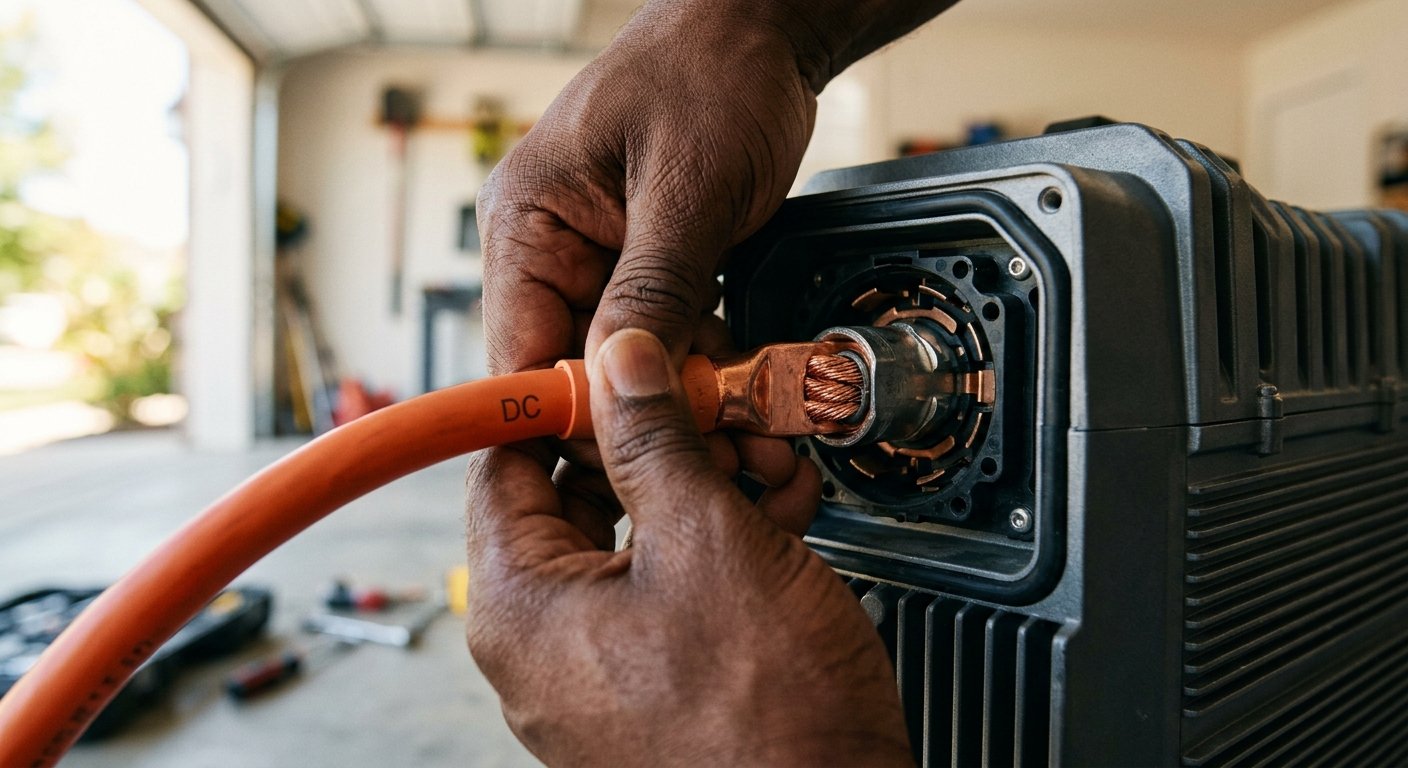
The concept is straightforward. Solar panels produce direct current (DC) electricity. An inverter converts that to alternating current (AC) for your home’s circuits. A battery system, connected to this setup, absorbs any energy your home doesn’t immediately consume. When the sun goes down—or on a particularly cloudy afternoon—the inverter draws from the battery instead of the grid.
Modern hybrid inverters manage this process automatically and intelligently, prioritizing solar power first, battery second, and grid power only when both are depleted. Some systems can even be programmed to avoid drawing grid power during peak tariff hours, maximizing your savings.
Solar panels generate power
Panels convert sunlight into electricity throughout the day, producing more than a household needs during peak sun hours.
Surplus energy charges the battery
Energy your home isn’t using in real time flows into the battery bank, stored safely for later use.
Battery powers your home at night
After sunset, the system automatically switches to battery power, keeping lights, appliances, and cooling running without grid electricity.
Grid acts as a safety net
If battery capacity is fully depleted, the grid supplements—but in a well-sized system, this happens rarely.
Choosing the Right Battery: Lithium vs. Lead-Acid
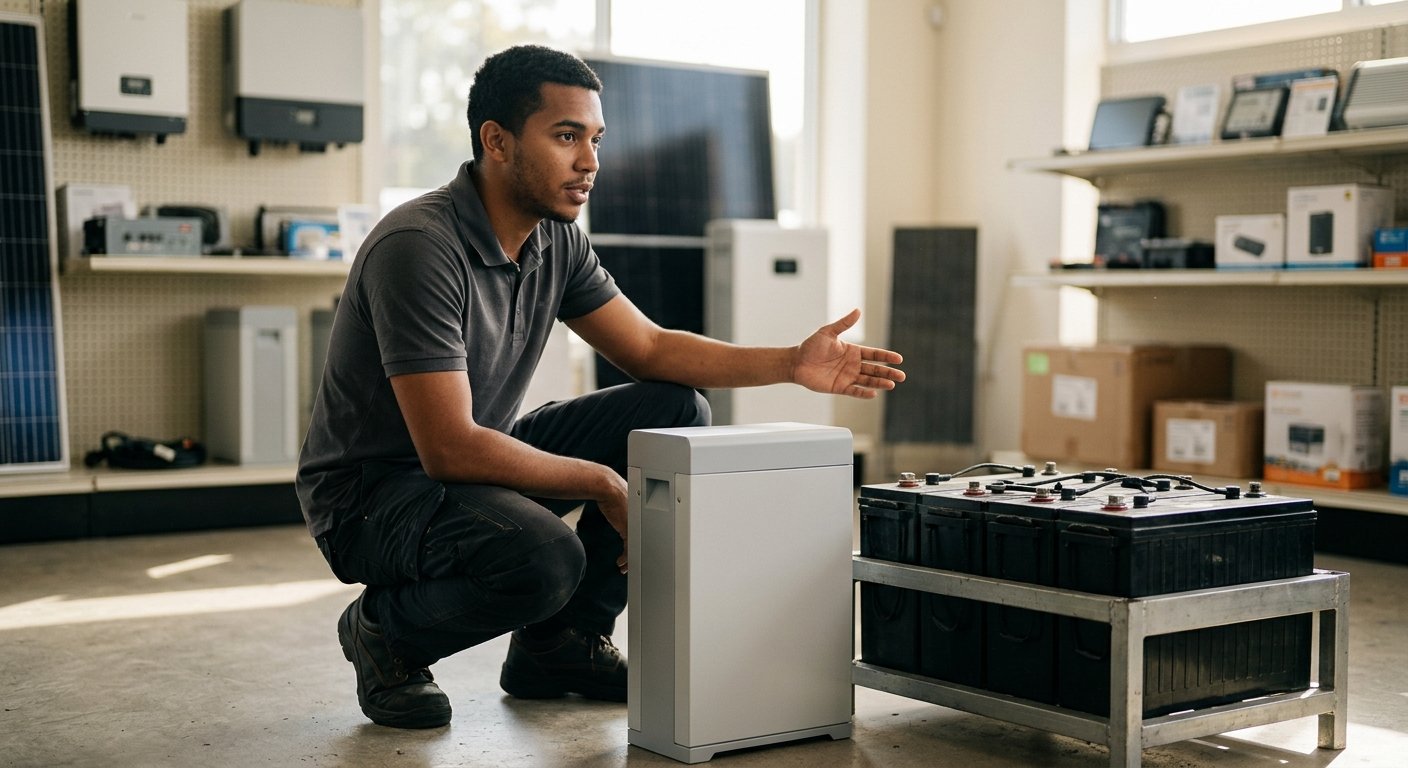
For most Caribbean homeowners and businesses in 2026, lithium iron phosphate (LFP) batteries are the clear choice. They’ve replaced older lead-acid technologies in virtually every new residential and commercial solar installation, and for good reason. Understanding the difference helps you make a confident investment decision.
| Feature | Lithium Iron Phosphate (LFP) | Lead-Acid (AGM/Gel) |
|---|---|---|
| Lifespan (cycles) | 3,000–6,000+ cycles | 500–1,200 cycles |
| Usable capacity | 80–100% depth of discharge | 30–50% depth of discharge |
| Heat tolerance | Excellent for tropical climates | Degrades faster in heat |
| Maintenance | Minimal | Regular checks required |
| Upfront cost | Higher | Lower |
| Long-term value | Superior | Lower over system lifetime |
The U.S. Department of Energy’s Solar Energy Technologies Office notes that battery storage costs have declined dramatically over the past decade, making lithium systems increasingly accessible for residential applications. This trend benefits homeowners across the Caribbean who are sizing up their first solar-plus-storage installation.
When comparing battery quotes, look at the cost per usable kilowatt-hour—not just the sticker price. A lithium battery with twice the usable capacity and three times the lifespan is almost always better value than a cheaper lead-acid alternative, even if the upfront number looks attractive.
Sizing a Battery System for Your Aruba Home or Business
Battery sizing depends on two main factors: how much energy your household or business consumes daily, and how many hours of independence you want from the grid. A typical Aruba home might use between 15 and 30 kWh per day, depending on air conditioning usage, appliances, and occupancy. A well-designed system aims to cover evening and nighttime demand comfortably without over-sizing to the point where your investment doesn’t make financial sense.
For residential solar systems, B Energy designs solutions starting from 5 kWp, with battery storage scaled to match real household consumption data. For commercial solar solutions—supermarkets, hotels, restaurants, office buildings—systems can scale to 100 kWp and beyond, with battery banks sized for critical load backup or full overnight autonomy. There’s no universal formula; a proper energy audit and on-site assessment lead to the right answer every time.
Coastal Installation: What Makes Aruba Different
Installing energy storage solutions in a Caribbean coastal environment isn’t the same as a standard installation elsewhere. Salt-laden air accelerates corrosion on metal components, cable terminations, and enclosure hardware. Equipment that performs reliably inland can degrade far faster when installed near the ocean without the right protective measures.
As Caribbean solar energy specialists with hands-on island expertise, the B Energy team specifies marine-grade enclosures, corrosion-resistant conduit, and appropriate IP (ingress protection) ratings for every battery installation in Aruba. Battery location within the building matters too—a sheltered utility room protects equipment from direct sun exposure and keeps operating temperatures in the ideal range for lithium battery longevity.
Aruba’s consistent trade winds are a gift for natural cooling, but they also carry salt aerosols year-round. Never skip marine-grade protection on battery enclosures, regardless of how far from the shoreline your property sits. This is non-negotiable in the Caribbean context.
What to Expect: Investment and Payback
B Energy typically quotes a 3–5 year payback period for solar-plus-storage systems in Aruba, accounting for local electricity tariffs and average solar irradiance. After payback, the energy your system generates is essentially free for the remaining life of the equipment—panels commonly operate for 25+ years, and quality lithium batteries for 10–15 years with normal cycling.
The International Renewable Energy Agency (IRENA) consistently ranks solar-plus-storage as one of the most cost-effective pathways to energy independence for island communities. For a deeper look at how B Energy structures complete hybrid energy systems, the battery storage and hybrid energy page covers the full technical and financial picture.
The Bigger Picture: Community and Environment
Every battery storage system installed in Aruba represents more than a financial decision. It’s a statement about the kind of island community residents want to build—one that relies on abundant local sunshine rather than imported fossil fuels. When enough homes and businesses make this shift, the cumulative effect transforms how the entire island generates and consumes energy.
For business owners, solar plus storage also signals something powerful to employees, customers, and partners: a commitment to sustainable practices that goes beyond words. In 2026, sustainability credentials matter to consumers, and a visible solar installation with real energy independence is a story worth telling.
Frequently Asked Questions
How many batteries do I need for a typical Aruba home?
It depends on your daily energy consumption and how much grid independence you want. Most residential systems in Aruba use between 10 and 30 kWh of battery capacity. A proper energy audit—reviewing your electricity bills and appliance usage—is the accurate starting point, and B Energy conducts these assessments as part of every consultation.
Will my solar battery system work during a grid outage?
Yes, provided your system is configured for backup operation. Not all solar inverters automatically island (disconnect from the grid and run independently) during an outage—this requires a hybrid or off-grid capable inverter paired with your battery bank. All B Energy systems designed for backup capability include this functionality.
How long do lithium solar batteries last in the Caribbean heat?
Quality lithium iron phosphate batteries are rated for 3,000–6,000+ charge cycles and are designed to operate in warm climates. Proper installation—sheltered from direct sun, with adequate ventilation—keeps operating temperatures in the optimal range and maximizes battery lifespan, typically 10–15 years in Caribbean conditions.
Is solar battery storage worth it if I already have solar panels?
In most cases, yes. Without storage, surplus daytime energy is either exported at low credit rates or wasted. Adding a battery captures that energy and shifts it to evenings when demand—and grid costs—are higher. The financial case depends on your specific tariff structure and consumption pattern, which B Energy can assess for your property.
Can businesses benefit from solar battery storage too?
Absolutely. Commercial properties often have high daytime energy costs and need reliable power for operations. Solar plus storage can significantly reduce peak demand charges, provide backup power continuity, and support sustainability goals. B Energy designs commercial systems from small retail premises to large facilities requiring 100+ kWp.
Ready to explore solar battery storage for your home or business?
Connect with B Energy’s Caribbean solar specialists in Oranjestad for a no-obligation consultation—we’ll assess your energy needs and design a system sized for real island life.

About B Energy
B Energy is a mission-driven solar energy company serving Caribbean homeowners and businesses in Aruba and surrounding islands. We specialize in designing and installing residential and commercial solar systems (5-100+ kWp) optimized for tropical climates, coastal environments, and hurricane resilience. Our community-focused approach combines a typical 3-5 year payback, energy independence solutions, and environmental stewardship, empowering island residents to lower electricity costs while contributing to a sustainable Caribbean future. Visit b-energy.life →