
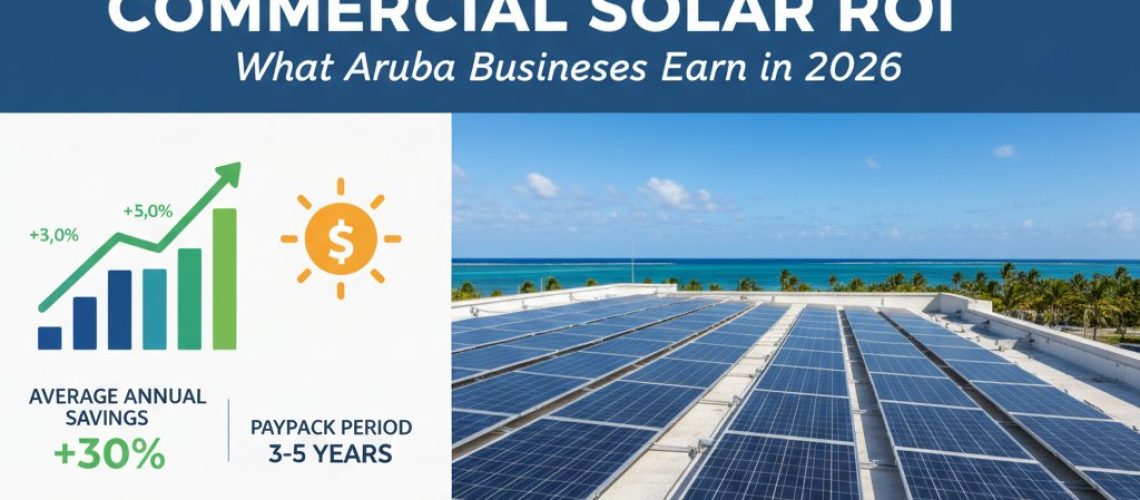
Aruba businesses are achieving remarkable returns on solar investments in 2026, with many commercial properties seeing their solar systems pay for themselves in just 3-4 years. With electricity rates among the highest in the Caribbean and solar technology more accessible than ever, the question for Aruba business owners isn’t whether to go solar—it’s how quickly they can start capturing these financial benefits while contributing to the island’s energy independence.
The commercial solar landscape in Aruba has transformed dramatically. What once seemed like a significant upfront investment now represents one of the smartest financial decisions business owners can make, with predictable returns that far outpace traditional investments while simultaneously reducing operational costs and environmental impact.
The Real Numbers Behind Commercial Solar ROI in Aruba
Understanding commercial solar ROI requires looking beyond simple payback periods to examine the full financial picture that Aruba businesses are experiencing in 2026. The returns are compelling across nearly every commercial sector.
A typical commercial solar installation aruba ranges from 20 kWp for small retail operations to 100+ kWp for larger manufacturing facilities, hotels, and shopping centers. The average cost per watt installed has decreased to approximately $2.50-$3.50 in 2026, making a 50 kWp system investment around $125,000-$175,000 before incentives.
Here’s where the mathematics become exciting for business owners. With Aruba’s electricity rates averaging $0.38-$0.42 per kWh for commercial customers—among the highest in the region—a 50 kWp system generating approximately 75,000 kWh annually can save businesses $28,500-$31,500 per year. This translates to a return on investment in 4-5.5 years, after which the system generates essentially free electricity for its remaining 25+ year lifespan.
First-Year Returns and Long-Term Gains
The financial impact begins immediately. From the first month of operation, businesses see reduced utility bills, with many commercial properties reducing their grid dependence by 60-90% depending on system sizing and energy consumption patterns.
Over a 25-year period, that same 50 kWp system represents total savings of $712,500-$787,500 in avoided electricity costs, assuming modest 2% annual utility rate increases. When you factor in that electricity rates in Aruba have historically increased 3-4% annually, the actual long-term savings often exceed $850,000.
Industry-Specific ROI Performance in Aruba
Different business sectors are experiencing varied but consistently positive returns from their commercial solar panels caribbean investments. Understanding these patterns helps business owners set realistic expectations.
Hospitality and Tourism
Hotels, guesthouses, and vacation rental properties represent some of the strongest performers for business solar installation aruba. These properties typically operate 24/7 with significant daytime cooling and operational loads that align perfectly with solar production periods.
A 75 kWp system on a mid-sized hotel can offset $42,000-$47,000 annually in electricity costs, achieving payback in 3.5-4 years. The environmental messaging also resonates strongly with eco-conscious tourists, creating marketing value beyond pure financial returns.
Retail and Office Spaces
Retail stores and professional offices with strong daytime operations see excellent alignment between solar production and consumption. A 30 kWp system serving a retail location typically saves $17,000-$19,000 annually, with ROI periods of 4-5 years.
Office buildings benefit particularly from predictable weekday consumption patterns that maximize self-consumption rates, often achieving 75-85% utilization of solar production during business hours.
Manufacturing and Industrial
Manufacturing facilities and warehouses often have the roof space and energy consumption to justify larger 100+ kWp installations. These operations frequently achieve the fastest payback periods—sometimes under 3 years—due to consistently high daytime energy demands and the ability to size systems for maximum production.
Industrial operations also benefit from improved power quality and reduced demand charges, adding hidden value beyond simple kWh savings.
Restaurants and Food Service
Restaurants face unique energy challenges with refrigeration running constantly and peak cooking loads. A 25 kWp system can reduce monthly electricity expenses by $1,500-$2,000, improving thin profit margins significantly while demonstrating environmental commitment to customers.
Understanding Business Energy Independence Beyond ROI
While financial returns drive initial decision-making, Aruba businesses discover that business energy independence delivers value that transcends simple dollar calculations. This independence represents operational resilience and strategic advantage in an increasingly competitive marketplace.
Energy independence means predictable operating costs in an era of volatile utility rates. When your business generates its own power, you’re insulated from rate increases, fuel surcharges, and grid-related cost fluctuations. This predictability enables better financial planning and budgeting accuracy.
For many Aruba businesses, solar has become a competitive differentiator. Customers increasingly choose businesses demonstrating environmental responsibility. A visible commitment to renewable energy strengthens brand reputation, particularly in tourism-dependent sectors where sustainability messaging matters.
Solar installations also provide physical evidence of long-term thinking and community investment. When customers see solar panels on your roof, they recognize a business committed to Aruba’s sustainable future—a powerful statement in a close-knit island community.
Commercial Solar Financing Options Accelerating Adoption
The expansion of commercial solar financing options in 2026 has removed traditional barriers to entry, enabling businesses of all sizes to capture solar ROI without significant upfront capital investment.
Traditional Commercial Loans
Local banks now offer specialized solar financing with terms ranging from 5-12 years at competitive rates. Many businesses structure loans so monthly payments are lower than their electricity savings, creating positive cash flow from day one.
Equipment Financing and Leases
Equipment financing treats solar systems like any other capital investment, with flexible terms that preserve working capital for core business operations. Monthly payments are predictable, and the system generates immediate savings that offset financing costs.
Power Purchase Agreements (PPAs)
While less common in Aruba than other markets, some larger commercial installations utilize PPA structures where third-party investors own the system and sell electricity to the business at rates below utility costs. This approach requires zero upfront investment while delivering immediate savings.
Maximizing ROI Through System Design and Optimization
Achieving optimal commercial solar roi requires more than simply installing panels—it demands thoughtful system design tailored to your specific business operations and consumption patterns.
Right-Sizing Your System
The temptation to “go big” must be balanced against actual consumption patterns and available roof space. Oversized systems may produce excess energy with limited compensation value, while undersized installations leave money on the table. Professional energy audits identify the optimal system size for maximum ROI.
Consumption Pattern Alignment
Businesses with strong daytime loads achieve better ROI by maximizing self-consumption. Operations running primarily at night may see longer payback periods unless battery storage is incorporated. Understanding your load profile is essential for accurate ROI projections.
Quality Component Selection
Premium panels and inverters cost more initially but deliver better long-term performance and reliability. In Aruba’s coastal environment with salt air exposure, choosing marine-grade components and proper protective coatings prevents premature degradation and protects your investment.
Coastal Installation Considerations for Aruba Businesses
The island environment presents unique installation requirements that directly impact system longevity and ROI. Aruba’s trade winds, salt air, and intense solar exposure demand specialized approaches.
Corrosion protection is paramount. Stainless steel or specially coated aluminum mounting systems prevent rust and structural degradation. Regular maintenance schedules including cleaning and connection inspections preserve system performance and prevent costly repairs.
Wind loading calculations ensure systems withstand sustained trade winds. Proper racking design and secure mounting protect your investment while maintaining optimal panel angles for energy production.
Tax Incentives and Depreciation Benefits
Aruba businesses benefit from various incentives that improve solar ROI. While specific programs evolve, the 2026 landscape includes several valuable opportunities.
Accelerated depreciation allows businesses to write off solar investments faster than traditional assets, reducing taxable income in early years. This benefit essentially provides an interest-free loan from future tax obligations, improving effective ROI.
Import duty exemptions on solar equipment reduce system costs by 5-10%, directly improving payback calculations. Local incentive programs periodically offer additional rebates or favorable net metering arrangements that enhance returns.
Real-World Success Stories: Aruba Businesses Leading the Way
Across Aruba, forward-thinking businesses are proving the commercial viability of solar energy while inspiring others to follow their lead. Retail establishments that installed systems in 2022-2023 are now operating in pure profit mode, having recovered their investments and enjoying free electricity.
Manufacturing operations report that solar has become their most successful cost-reduction initiative, outperforming other operational efficiency improvements. Hospitality properties market their solar installations as guest amenities, attracting environmentally conscious travelers willing to pay premium rates.
These success stories create momentum throughout the business community. Each installation demonstrates what’s possible, encouraging neighbors and competitors to explore their own solar potential.
Looking Forward: Solar as Business Strategy
In 2026, commercial solar has evolved from alternative energy experiment to mainstream business strategy. The combination of high electricity costs, proven technology, accessible financing, and strong returns makes solar one of the most reliable investments available to Aruba business owners.
The businesses capturing these benefits today are positioning themselves for long-term competitive advantage. Lower operating costs translate to improved profit margins, competitive pricing flexibility, and resilience against future utility rate increases.
Beyond individual business benefits, every commercial solar installation strengthens Aruba’s energy independence and environmental stewardship. Collectively, businesses are reducing the island’s fossil fuel dependency, decreasing carbon emissions, and creating a more sustainable economic foundation for future generations.
Taking the Next Step Toward Commercial Solar
Understanding commercial solar ROI is just the beginning. The next step involves professional assessment of your specific property, consumption patterns, and financial objectives to develop a customized solar strategy that maximizes returns while aligning with your business goals.
Start by gathering 12 months of utility bills to establish baseline consumption and costs. This data enables accurate system sizing and ROI projections specific to your operation. Schedule consultations with experienced commercial solar installers who understand Aruba’s unique requirements and can provide detailed financial analysis.
Request multiple proposals to compare approaches, pricing, and projected returns. Ask about component warranties, maintenance requirements, and production guarantees. The right solar partner will provide transparent, detailed projections based on actual data rather than optimistic estimates.
The businesses that thrive in Aruba’s future will be those making strategic investments today in energy independence, operational efficiency, and environmental responsibility. Commercial solar delivers on all three fronts while generating measurable financial returns that strengthen your bottom line for decades to come.
The opportunity is clear, the technology is proven, and the returns are real. Aruba businesses installing commercial solar systems in 2026 aren’t just reducing electricity costs—they’re investing in energy independence, competitive advantage, and a sustainable island future. The question isn’t whether commercial solar makes financial sense, but how quickly you can start capturing these benefits for your business.