
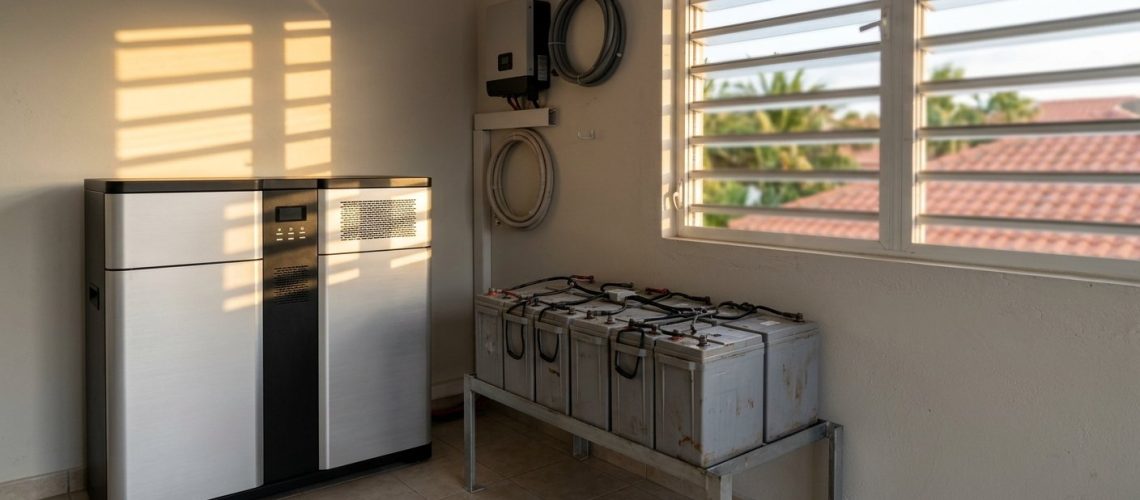
Here’s a fact that surprises many Aruba homeowners: the solar panels on your roof are only half the story. The battery system you pair them with determines whether you actually achieve energy independence—or simply reduce your dependence on WEB Aruba during daylight hours. With electricity costs among the highest in the Caribbean region, choosing the right solar battery storage in the Caribbean isn’t a minor technical detail. It’s a decision that shapes your daily comfort, long-term savings, and contribution to a more sustainable Aruba.
Two technologies dominate today’s residential and commercial market: lithium-ion batteries and traditional lead-acid batteries. Both store solar energy. Both can power your home when the grid goes down. But they perform very differently in Aruba’s tropical environment—and the right choice depends on your goals, budget, and how you want to live with solar energy for the next decade and beyond.
How Solar Battery Storage Actually Works
Before comparing technologies, it helps to understand what a battery does in a solar plus storage Caribbean setup. During sunny hours—and Aruba gets plenty of them—your solar panels generate more electricity than your home typically uses. Without storage, that surplus flows back to the grid or simply goes to waste. With a battery, that excess energy is captured and saved for evenings, cloudy periods, or unexpected outages.
This is what transforms a standard solar installation into a true hybrid solar system in Aruba: the ability to generate, store, and deploy your own clean energy on your schedule. It’s the difference between reducing your bills and genuinely owning your power supply.
Lead-Acid Batteries: The Traditional Choice
Lead-acid batteries have powered off-grid and backup systems for over a century. They’re familiar, widely available, and carry a lower upfront price tag—which makes them appealing at first glance. For Aruba homeowners exploring solar backup power on a tighter budget, they often appear in early conversations.
Where Lead-Acid Falls Short in the Tropics
The challenges become clear when you factor in Aruba’s conditions and long-term ownership costs:
- Limited usable capacity: Lead-acid batteries should only be discharged to about 50% of their total capacity to avoid shortening their lifespan. A 10 kWh lead-acid bank effectively gives you only 5 kWh of usable power.
- Heat sensitivity: Aruba’s warm, consistent temperatures accelerate chemical degradation in lead-acid cells. What’s rated for 5-7 years in a temperate climate may deliver 3-4 years in tropical conditions.
- Regular maintenance: Flooded lead-acid batteries require periodic water topping, equalization charging, and ventilation management—ongoing commitments that many homeowners underestimate.
- Weight and space: A lead-acid bank capable of backing up a typical Aruba home is heavy and bulky, requiring dedicated installation space with proper ventilation.
- Efficiency losses: Lead-acid systems lose more energy during charge and discharge cycles, meaning you’re capturing and using less of what your solar panels produce.
The lower purchase price often evaporates when you calculate replacement cycles, maintenance costs, and reduced system efficiency over a 10-year horizon.
Lithium Batteries: Built for Modern Solar Living
Lithium iron phosphate (LiFePO4) batteries represent the current gold standard for residential and commercial solar battery installation. They were designed specifically to pair with modern solar systems—and they show it in virtually every performance category that matters to Aruba homeowners.
The Lithium Advantage in a Tropical Climate
- Deep discharge capability: Lithium batteries safely discharge to 80-90% of their capacity. That same 10 kWh lithium battery delivers 8-9 kWh of real, usable power—nearly double the effective output of a lead-acid equivalent.
- Longer lifespan: Quality lithium systems are rated for 3,000 to 6,000+ charge cycles, translating to 10-15 years of reliable service. According to the U.S. Department of Energy, lithium-ion batteries offer significantly longer cycle lives than lead-acid alternatives, making them more cost-effective over a system’s lifetime.
- Higher round-trip efficiency: Lithium systems operate at 95%+ efficiency, meaning almost all the solar energy you store comes back out when you need it. Lead-acid systems typically achieve 70-85%.
- Thermal stability: Modern LiFePO4 chemistry handles heat well—an important advantage in Aruba’s consistently warm environment.
- Zero maintenance: Unlike flooded lead-acid systems, lithium batteries require no water, no equalization charging, and no venting concerns. Once installed, they work quietly in the background.
- Compact and scalable: Lithium batteries pack more energy into less space, and most modern systems allow you to add capacity as your needs grow—ideal for homeowners who start with a 5 kWp system and later expand.
The Real Cost Comparison: Beyond the Price Tag
Lithium batteries cost more upfront—there’s no disputing that. A quality lithium system may run 1.5 to 2 times the initial investment of a comparable lead-acid setup. But this comparison only tells part of the story.
When you account for a 10-15 year ownership window, the math shifts significantly. Lead-acid batteries in Aruba’s climate will likely require replacement once or even twice during that period. Add maintenance costs, efficiency losses (which translate directly to higher electricity bills), and the cost of additional capacity needed to compensate for limited depth of discharge—and the total cost of ownership for lithium becomes equal or lower.
For homeowners and businesses targeting the 3-5 year ROI that characterizes well-designed solar installations, lithium’s superior performance and longevity are key inputs, not optional upgrades. The International Renewable Energy Agency has documented that battery storage costs have declined dramatically over the past decade, making lithium systems increasingly accessible for Caribbean homeowners and businesses.
Sizing Your Battery System for Aruba
Battery sizing depends on several factors unique to your home or business: your daily energy consumption, how many hours of backup power you want, and whether you’re designing primarily for energy shifting (storing solar for evening use) or full backup resilience.
A typical Aruba home with moderate air conditioning, standard appliances, and evening lighting might need 10-20 kWh of usable storage to meaningfully reduce grid dependence. Larger homes or businesses with significant cooling loads may require 30 kWh or more. The beauty of modern lithium systems is their modularity—you can start with what fits your current budget and expand as needed.
Our battery storage and hybrid energy solutions are sized to match your actual consumption patterns, ensuring you’re not over-investing in capacity you won’t use or under-investing and still relying heavily on grid power. For homeowners also exploring full solar system design, our residential solar systems page explains how panels and storage work together as an integrated system.
What About Commercial Applications?
For businesses in Oranjestad, energy storage solutions in the Caribbean take on added dimensions. Avoiding peak demand charges, maintaining operations during outages, and demonstrating sustainability commitment to customers all factor into the storage decision.
Commercial lithium systems in the 30-100+ kWp range deliver the reliability and cycle performance that business operations demand. When your refrigeration, point-of-sale systems, or production equipment depends on consistent power, lithium’s depth of discharge and round-trip efficiency aren’t just financial benefits—they’re operational necessities. Learn more about how storage integrates with larger installations through our commercial solar solutions.
Frequently Asked Questions
How long do lithium solar batteries last in Aruba’s climate?
Quality lithium iron phosphate batteries are rated for 3,000 to 6,000+ charge cycles, which typically translates to 10-15 years of useful life. Aruba’s warm climate is well within the operating parameters of modern LiFePO4 chemistry, making lithium an excellent long-term investment for island homeowners.
Are lead-acid batteries still worth considering for solar in Aruba?
In most cases, no. While lead-acid batteries have a lower upfront cost, their reduced usable capacity, shorter tropical lifespan, maintenance requirements, and lower efficiency make the total cost of ownership higher than lithium over a 10-year period. For most Aruba homeowners and businesses, lithium delivers better value.
How many batteries do I need for my Aruba home?
This depends on your daily energy consumption and backup goals. A proper solar battery installation begins with an energy audit to understand your usage patterns. Most residential systems in Aruba benefit from 10-20 kWh of usable lithium storage, though larger homes may need more. A professional assessment ensures accurate sizing.
Can I add battery storage to an existing solar system?
Yes, in most cases. Many existing solar installations can be upgraded to include battery storage, converting a standard grid-tied system into a hybrid solar system. The compatibility of your existing inverter with battery storage is the key technical consideration—something our team assesses during any consultation.
What happens to my battery during a grid outage?
With a properly designed hybrid system, your battery automatically provides solar backup power during outages. Your essential loads—lights, fans, refrigerator, and selected outlets—continue running from stored solar energy. The transition is typically seamless, often happening in milliseconds.
Powering Aruba’s Future, One Home at a Time
Choosing between lithium and lead-acid batteries isn’t just a technical decision—it’s a statement about how you want to live on this island. Lithium battery solar systems represent a commitment to energy independence that pays dividends for a decade and beyond, while contributing to a cleaner, more self-sufficient Aruba.
As Caribbean solar energy specialists with deep local expertise in Oranjestad and across Aruba, B Energy designs storage solutions that match your real life—not just a spec sheet. We believe every home and business that generates and stores its own clean energy makes our island more resilient, more sustainable, and a better place to live.
Ready to find the right battery storage solution for your home or business? Contact B Energy today for a personalized assessment. Let’s design an energy system that gives you the independence, savings, and peace of mind you deserve—right here in Aruba.