

Going off-grid with solar in Aruba means investing in a complete independent power system—panels, batteries, inverters, and wiring—sized to replace utility electricity entirely. Total costs depend on your home’s energy consumption and system size, but B Energy typically quotes a 3–5 year payback period for well-designed residential systems. Understanding what drives cost helps homeowners make confident, informed decisions.
- Off-grid solar systems include four core components: solar panels, battery storage, an inverter, and a charge controller—each affecting total cost.
- Residential systems in Aruba typically range from 5 kWp to 100+ kWp depending on household size and energy needs.
- B Energy’s Caribbean-specific designs account for coastal environments, salt air, and year-round sun exposure.
- A properly sized system eliminates dependence on Aruba’s utility grid, providing energy security and long-term savings.
- The 3–5 year payback estimate makes off-grid solar one of the strongest financial investments available to island homeowners.
Why Aruba Homeowners Are Turning to Independent Solar Power
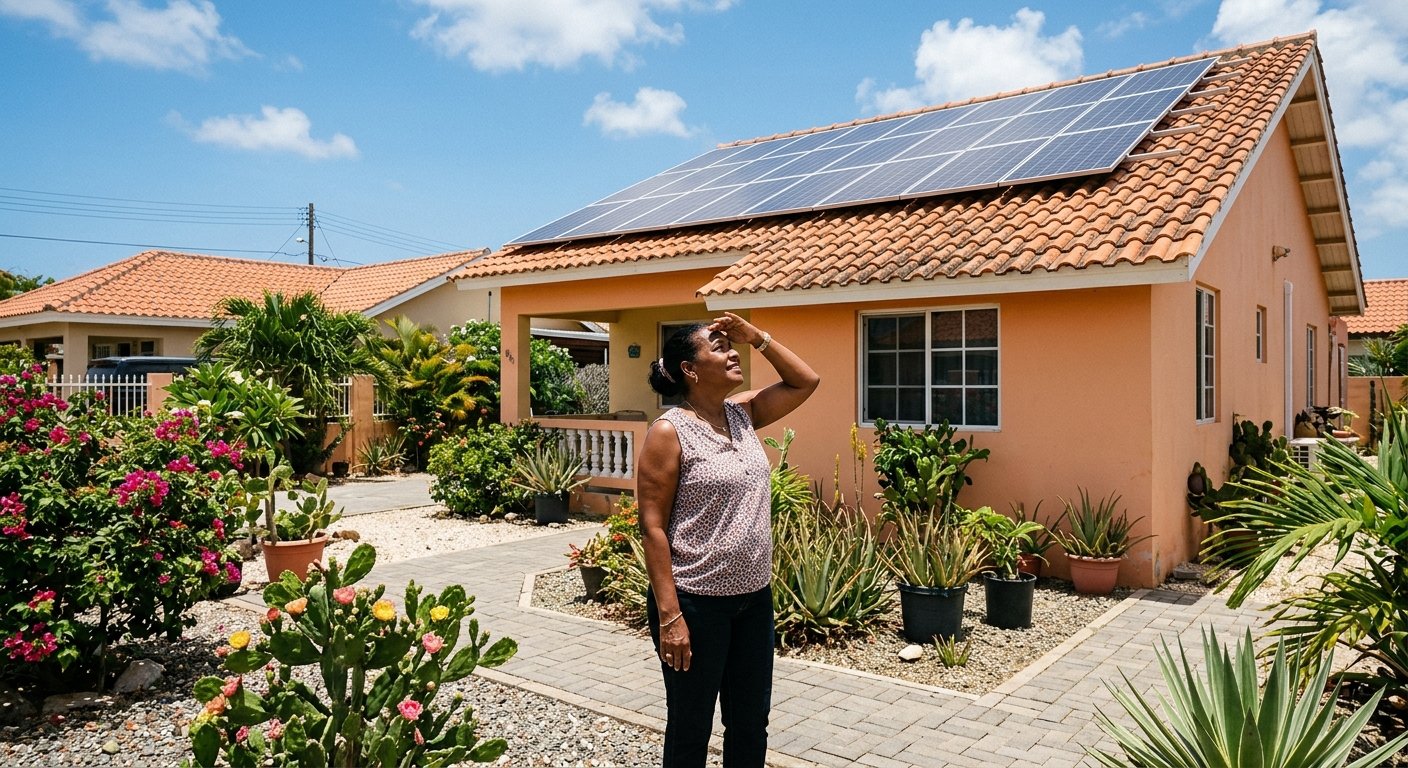
Electricity on island is expensive. Aruba’s utility rates reflect the cost of importing fossil fuels, a reality that puts pressure on household budgets every single month. For many families in Oranjestad and across the island, the appeal of independent solar power isn’t abstract—it’s the freedom to stop watching the meter and start investing in something that belongs to them.
Aruba also enjoys exceptional solar irradiance. The island sits in one of the most consistently sunny regions on Earth, making it an ideal environment for solar generation. According to the Global Solar Atlas, Aruba receives among the highest photovoltaic power output potential in the Caribbean, meaning solar panels here simply produce more energy per installed kilowatt than in most other parts of the world.
That’s the foundation of the financial case. Sun is free. Fuel is not.
Sun is free. Fuel is not. Every kilowatt-hour your panels generate is a kilowatt-hour you don’t pay for.
The Four Core Off-Grid Solar Components

Understanding an off-grid solar cost breakdown starts with knowing what you’re actually buying. A complete off-grid solar system is made up of four essential components, each with its own role and price contribution.
Solar Panels
The panels themselves capture sunlight and convert it to direct current (DC) electricity. For a typical Aruban household, a system between 5 kWp and 20 kWp is common. Larger homes or businesses may require 50–100+ kWp. Panel costs depend on brand, efficiency rating, and quantity—higher-efficiency panels cost more upfront but produce more power per square meter, which matters when roof space is limited.
Battery Storage
Battery storage is typically the largest cost driver in an off-grid system. Because you’re generating power during the day but consuming it around the clock, batteries store the surplus for nighttime and cloudy periods. Lithium iron phosphate (LFP) batteries have become the island standard for their longevity, safety, and performance in tropical heat. Battery capacity is sized based on how many days of autonomy you want—the number of days the system can power your home without any solar generation.
Inverter
The inverter converts DC electricity from the panels and batteries into alternating current (AC) that your home’s appliances actually use. For off-grid systems, a hybrid inverter handles both solar input and battery management simultaneously. Quality matters enormously here—an undersized or low-quality inverter creates bottlenecks that reduce the whole system’s performance.
Charge Controller
The charge controller regulates the flow of energy from panels to batteries, preventing overcharging and protecting battery life. MPPT (Maximum Power Point Tracking) controllers are the current best practice for tropical installations, extracting maximum efficiency from panels even during partial shading or varying sun angles.
What Drives the Total Cost of an Off-Grid Solar Caribbean System

No two homes use energy the same way, and no two off-grid systems cost the same. The variables that most significantly influence your total investment include:
- Daily energy consumption (kWh/day): Air conditioning is typically the dominant load in Aruba’s climate. A home running multiple AC units requires substantially more capacity than one relying on fans and natural ventilation.
- Days of autonomy required: Do you want two days of battery backup or five? More autonomy means more batteries—and more cost.
- Roof orientation and shading: Ideally, panels face true south with minimal obstruction. Non-ideal installations sometimes require additional panels to meet production targets.
- System scalability: Installing a system designed to expand later can reduce upfront costs while protecting future flexibility.
- Installation complexity: Ground-mounted vs. rooftop, flat concrete roofs vs. pitched structures, and existing electrical infrastructure all affect labor costs.
Before requesting a quote, audit your last three electricity bills. Average your monthly consumption in kWh. This single number is the most important input for accurate off-grid system sizing—and it saves time in every consultation.
Coastal Considerations: Why Caribbean Installation Is Different
Aruba’s coastal environment is beautiful and demanding. Salt air accelerates corrosion on standard mounting hardware, connectors, and inverter enclosures. A system installed in Oranjestad without marine-grade components can degrade significantly faster than one properly specified for the environment.
As Caribbean solar energy specialists, the B Energy team designs every system with coastal durability in mind. That means corrosion-resistant racking, IP-rated (Ingress Protection) enclosures for electronics, and panel selections with proven track records in salt-spray conditions. The International Electrotechnical Commission publishes the IEC 61701 standard specifically for salt mist corrosion testing of photovoltaic modules—a certification B Energy treats as a baseline requirement, not an optional upgrade.
This attention to local conditions is one of the most meaningful differences between a system designed for Aruba and a generic solar package assembled without island expertise.
Off-grid solar components specified for continental climates may not carry the corrosion ratings needed for Aruba’s coastal air. A system that looks identical on a quote sheet can perform very differently five years in, depending on whether components were chosen with the Caribbean environment in mind.
Comparing On-Grid vs. Off-Grid: Choosing Your Path
| Consideration | Grid-Tied Solar | Off-Grid Solar |
|---|---|---|
| Utility independence | Partial | Complete |
| Battery storage required | Optional | Essential |
| Upfront cost | Lower | Higher |
| Energy security during outages | Limited | Full |
| Best for | Cost reduction | Independence + security |
| Ongoing utility bill | Reduced | Eliminated |
For homeowners who want to reduce bills while staying connected, a residential solar system tied to the grid can be an excellent starting point. For those seeking true energy independence—no utility bills, no grid dependency—the off-grid path delivers exactly that, at a higher initial investment that the 3–5 year payback framework puts into perspective.
Businesses evaluating the same decision can explore commercial solar solutions specifically designed for larger loads and operational continuity requirements.
The Long View: Community, Sustainability, and Island Identity
There’s something quietly powerful about generating your own electricity from the same sun that’s always defined Caribbean life. Every household that achieves energy independence reduces the island’s collective dependence on imported fuel, contributing to a more resilient and self-sufficient Aruba. According to the International Renewable Energy Agency (IRENA), small island developing states have some of the most compelling economic and environmental cases for solar adoption in the world—precisely because of their reliance on costly imported fossil fuels.
When a family in Oranjestad installs solar, they’re not just making a financial decision. They’re participating in something larger: a gradual, community-driven shift toward an island that powers itself cleanly, sustainably, and independently. That’s the vision that drives B Energy’s community-focused solar solutions every day.
Frequently Asked Questions
How much does an off-grid solar system cost in Aruba?
Total cost depends on system size, battery capacity, and installation complexity. B Energy designs systems from 5 kWp for modest households up to 100+ kWp for large homes or businesses, and quotes are based on your specific energy audit. The typical payback period B Energy cites is 3–5 years, after which the energy is effectively free.
What is the biggest cost driver in an off-grid solar Caribbean system?
Battery storage is almost always the largest single cost component. The amount of storage you need depends on your daily consumption and how many days of autonomy you want the system to provide. Lithium iron phosphate batteries are the preferred technology for Aruba’s climate due to their thermal stability and long cycle life.
Do off-grid solar systems work well in Aruba’s coastal climate?
Yes—when properly specified. Aruba’s high solar irradiance makes it an excellent environment for solar production. The key is ensuring all components meet marine-grade or coastal corrosion standards, including IEC 61701-certified panels and IP-rated enclosures for inverters and charge controllers. This is standard practice for B Energy’s island installations.
How long do off-grid solar components last?
Quality solar panels typically carry 25–30 year performance warranties. Lithium iron phosphate batteries generally provide 10+ years of reliable service with proper management. Inverters typically carry 5–10 year manufacturer warranties. Regular maintenance checks extend the life of every component in the system.
Is off-grid solar right for my home or business?
Off-grid solar is ideal if you want complete energy independence, have high utility costs, or experience reliability concerns with grid power. A professional energy audit—reviewing your actual consumption patterns and load profile—is the essential first step to determining whether off-grid or grid-tied solar best matches your goals and budget.
Ready to Explore Your Off-Grid Options?
Our Caribbean solar energy specialists will assess your home’s energy needs and design a system built specifically for Aruba—contact us to schedule your consultation.

About B Energy
B Energy is a mission-driven solar energy company serving Caribbean homeowners and businesses in Aruba and surrounding islands. We specialize in designing and installing residential and commercial solar systems (5-100+ kWp) optimized for tropical climates, coastal environments, and hurricane resilience. Our community-focused approach combines a typical 3-5 year payback, energy independence solutions, and environmental stewardship, empowering island residents to lower electricity costs while contributing to a sustainable Caribbean future. Visit b-energy.life →