
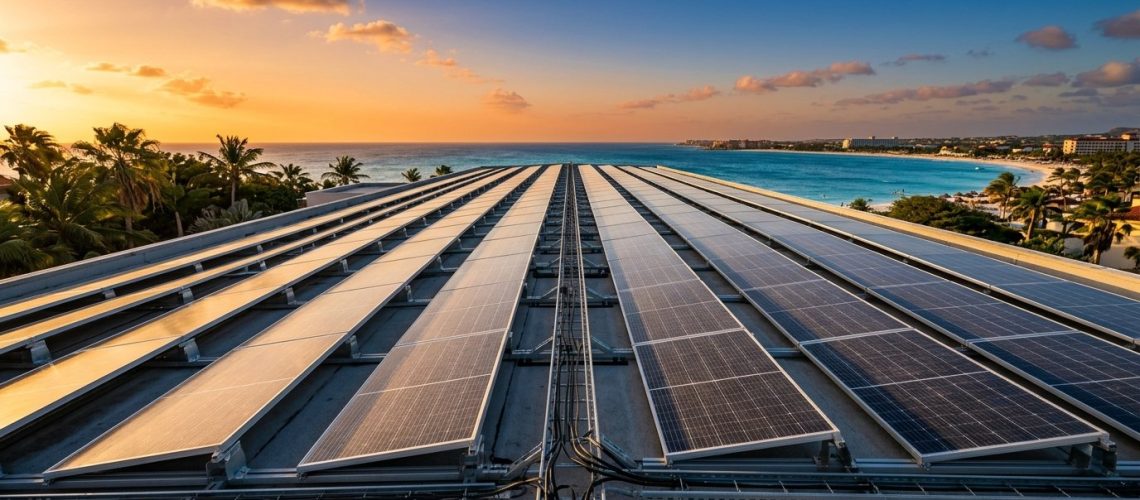
Electricity bills in Aruba consistently rank among the highest in the Caribbean — a reality that quietly erodes business profits month after month. For a mid-sized commercial operation, energy costs can consume 15–25% of operating expenses before a single employee is paid or a single product is sold. The good news? Solar energy offers a clear, calculable path to reversing that trend. And unlike many business investments, the returns are predictable — you can actually calculate your commercial solar ROI before signing a single contract.
This guide walks Aruba business owners through exactly how to do that — step by step, in plain language, with the right questions to ask and the right numbers to gather.
Why ROI Matters More Than the Price Tag
When business owners first explore solar, the upfront cost often triggers hesitation. A commercial solar system sized between 20 and 100+ kWp represents a meaningful capital investment. But focusing only on the price tag misses the bigger financial picture.
The smarter question isn’t “How much does it cost?” — it’s “How quickly does it pay me back, and what does it earn me over its lifetime?”
Commercial solar systems in Aruba typically deliver ROI within 3 to 5 years, depending on system size, energy consumption, and financing structure. After that breakeven point, the energy your system generates is essentially free — reducing operating costs for the remaining 20+ years of the system’s lifespan. That’s a fundamentally different way to think about the investment.
Step 1: Conduct a Solar Energy Audit
Before any ROI calculation is meaningful, you need accurate data about your current energy situation. A solar energy audit is the foundation of everything that follows.
Here’s what a proper energy audit captures:
- Monthly kWh consumption: Pull 12 months of electricity bills to understand your usage patterns across different seasons.
- Peak demand hours: When does your business draw the most power? Daytime-heavy operations (retail, manufacturing, hospitality) are ideal candidates for solar.
- Current rate per kWh: WEB Aruba’s commercial tariff structures directly affect your savings calculations.
- Available roof or ground space: Solar panels require unshaded surface area. Roof orientation, tilt, and shading from neighboring structures all factor in.
- Load growth projections: Are you expanding? Planning new equipment? Future energy needs should be built into your system design from day one.
Many businesses in Oranjestad are surprised to discover how much energy they’re consuming unnecessarily — making efficiency improvements and solar installations a powerful combination.
Step 2: Understand the Core ROI Formula
Commercial solar ROI isn’t complicated, but it does require honest inputs. Here’s the framework:
Calculate Your Annual Energy Cost Savings
Multiply your system’s estimated annual energy production (in kWh) by your current cost per kWh. This gives you your gross annual savings from solar generation.
For example: A 50 kWp commercial solar system in Aruba’s sunshine-rich environment might generate approximately 75,000–80,000 kWh per year. At a commercial rate, that translates into significant annual savings — money that stays in your business rather than flowing to the utility.
Factor In System Costs
Your total investment includes equipment, installation, permits, and any grid connection fees. Be sure to get a comprehensive quote that covers all of these — not just the panel cost.
Apply Available Incentives
Aruba has been actively advancing its renewable energy agenda. According to the Aruba Tourism Authority’s sustainability initiatives, the island has set ambitious goals for renewable energy integration. Tax incentives or import duty exemptions for solar equipment can meaningfully reduce your net investment — always verify current incentives with your installer and an accountant familiar with local regulations.
Simple Payback Period
Divide your net system cost (after incentives) by your annual savings. The result is your simple payback period in years. Most well-designed commercial solar systems in Aruba land in the 3–5 year range.
Lifetime Value
Multiply your annual savings by 25 years (a conservative lifespan estimate for quality solar panels), then subtract your total investment. This number — often 4 to 6 times the original investment — represents the true financial value of going solar.
Step 3: Explore Commercial Solar Financing Options
One of the most powerful levers in your ROI calculation is how you finance the system. Commercial solar financing in the Caribbean has evolved significantly, giving businesses more flexibility than ever before.
Cash Purchase
Buying outright maximizes your long-term ROI. You own the system from day one, capture all incentives, and begin saving immediately. If your business has available capital, this often produces the fastest payback and highest lifetime return.
Business Loans or Green Financing
Many Caribbean financial institutions now offer green lending products specifically for renewable energy investments. If your monthly loan payment is less than your monthly energy savings — which is frequently achievable — the system is cash-flow positive from the moment it switches on. This is sometimes called a “self-financing” investment, and it’s a compelling story to bring to your bank.
Leasing Arrangements
Some businesses prefer to lease solar systems, trading maximum ROI for lower upfront commitment. While you won’t capture all the long-term savings, leasing still reduces monthly energy expenses and positions your business as a sustainability leader.
Understanding these options is central to an accurate ROI projection. The International Renewable Energy Agency (IRENA) consistently reports that solar costs have declined globally, making financing structures increasingly favorable for commercial adopters.
Step 4: Size Your System Correctly
System sizing is where technical expertise meets financial planning. An undersized system leaves savings on the table. An oversized system may generate more power than your business can use, reducing the efficiency of your investment.
At B Energy, our approach as Caribbean solar energy specialists means we design commercial systems — ranging from 5 kWp to 100+ kWp — specifically matched to each business’s consumption profile, physical footprint, and growth trajectory in Oranjestad.
Coastal installations in Aruba also require specific hardware considerations. Salt air, wind exposure, and high UV intensity demand marine-grade mounting systems, corrosion-resistant racking, and panels rated for tropical conditions. These aren’t upgrades — they’re essentials that protect your investment and ensure long-term performance. Cutting corners here undermines your ROI projections over time.
Explore our commercial solar solutions to understand how we approach system design for Aruba businesses.
Step 5: Account for Long-Term Performance
Quality solar panels degrade slowly over time — typically around 0.5% per year in output. This means a system producing 80,000 kWh in year one will produce slightly less in year 25, and your ROI model should reflect this modest reduction. A conservative estimate builds this degradation rate into projections to avoid overstating long-term returns.
Maintenance costs should also be included. Commercial solar systems in Aruba require periodic cleaning (salt and dust accumulation affects panel efficiency) and occasional inverter checks. These costs are modest compared to energy savings but should appear in your financial model for accuracy.
According to the National Renewable Energy Laboratory (NREL), well-maintained solar systems routinely exceed 25-year performance benchmarks — making long-term ROI projections reliable when based on quality components.
The Intangible ROI: Brand, Resilience, and Community
Numbers tell most of the story, but not all of it. Aruba businesses that go solar gain something harder to quantify: a genuine competitive advantage in an increasingly sustainability-conscious market.
Tourism operators, hotels, restaurants, and retailers find that solar aligns powerfully with the values of modern consumers — particularly the international visitors who choose Aruba as their destination. Demonstrating environmental commitment isn’t just good ethics; it’s increasingly good business.
Energy independence also means your operations are less vulnerable to grid fluctuations or utility rate increases. When electricity prices rise — and historically, they have — your solar-protected business maintains stable operating costs while competitors absorb the shock.
For businesses considering a deeper step toward independence, our off-grid solar solutions offer options for complete energy self-sufficiency.
Frequently Asked Questions
How long does it take for a commercial solar system to pay for itself in Aruba?
Most commercial solar installations in Aruba reach their payback point within 3 to 5 years, depending on system size, current energy costs, financing structure, and available incentives. After payback, the system continues generating savings for 20+ additional years.
What size solar system does my business need?
System sizing depends on your monthly kWh consumption, available installation space, and future energy needs. Commercial systems typically range from 5 kWp for smaller operations to 100+ kWp for larger facilities. A proper solar energy audit is the starting point for accurate sizing.
Can I finance a commercial solar installation without large upfront capital?
Yes. Several commercial solar financing options are available, including green business loans and leasing arrangements. In many cases, monthly loan payments are offset by immediate energy savings, making solar cash-flow positive from day one.
What maintenance do commercial solar systems require in coastal environments like Aruba?
Coastal installations require periodic panel cleaning to remove salt residue and dust, along with routine inverter inspections. Systems built with marine-grade, corrosion-resistant components minimize maintenance needs and protect long-term performance. Annual maintenance costs are typically modest relative to energy savings.
Does Aruba offer any incentives for commercial solar installations?
Aruba has active renewable energy policies, and certain tax benefits or import duty exemptions may apply to commercial solar equipment. Incentive structures can change, so we recommend confirming current programs with your installer and a qualified local accountant before finalizing your ROI projections.
Your Next Step: Get the Numbers That Matter
Calculating your commercial solar ROI before installation isn’t just smart financial planning — it’s the foundation of a confident, well-informed decision. When you know your payback period, lifetime savings, and financing options before committing, solar stops being a leap of faith and becomes a strategic business investment.
As Oranjestad’s community-focused solar energy specialists, B Energy builds every commercial proposal around your specific numbers — not industry averages or generic projections. We start with your real consumption data, design a system matched to your business, and walk you through every element of your ROI before any commitment is made.
Ready to see what solar can actually do for your bottom line? Contact B Energy today to schedule your commercial solar energy audit and take the first step toward energy independence for your Aruba business.