Here’s a question worth sitting with: before you invest in anything significant for your home or business, wouldn’t you want to know exactly what you’re getting into? A solar feasibility study answers that question with clarity, data, and confidence—turning “I’ve been thinking about solar” into “I know exactly what solar will do for me.”
For homeowners and business owners in Oranjestad, this kind of assessment isn’t just useful—it’s transformative. Aruba’s electricity costs rank among the highest in the Caribbean region, and every month without solar is another month of paying more than necessary. A solar energy assessment in Aruba gives you a complete, property-specific picture before a single panel is installed.
Let’s walk through what a solar feasibility study actually reveals, why it matters, and how it sets the foundation for genuine energy independence on your island.
What Is a Solar Feasibility Study?
A solar feasibility study—sometimes called a solar site assessment or solar energy evaluation—is a professional analysis of your property’s potential to generate solar energy effectively. It’s not a sales pitch. It’s a detailed, evidence-based review that combines your energy consumption patterns, property characteristics, shading analysis, structural conditions, and financial projections into one comprehensive report.
Think of it as a health check for your energy future. Just as a doctor wouldn’t prescribe treatment without an examination, a responsible solar consultation in the Caribbean starts with understanding your unique situation before recommending any system size or configuration.
According to the U.S. Department of Energy’s Solar Energy Basics, site-specific assessments are a foundational step in any quality solar installation process, ensuring that system design matches actual conditions rather than generic estimates.
The Key Findings of Your Assessment
1. Your Current Energy Consumption Profile
The assessment begins by examining your electricity bills—typically 12 months of data. This reveals your peak consumption periods, average monthly usage in kilowatt-hours, and how your demand fluctuates. For a family home in Oranjestad, this might reflect air conditioning loads during hot afternoons. For a local business, it might highlight overnight security systems or morning commercial kitchen activity.
Understanding consumption patterns is what allows your solar system to be sized correctly—neither too small to make a meaningful dent in your bills, nor oversized in ways that don’t match your actual needs.
2. Solar Resource Potential on Your Roof
Aruba sits just outside the hurricane belt and enjoys one of the most consistent solar irradiance profiles in the Caribbean—roughly 5.5 to 6 peak sun hours per day year-round. But your specific property’s solar potential depends on more than geography.
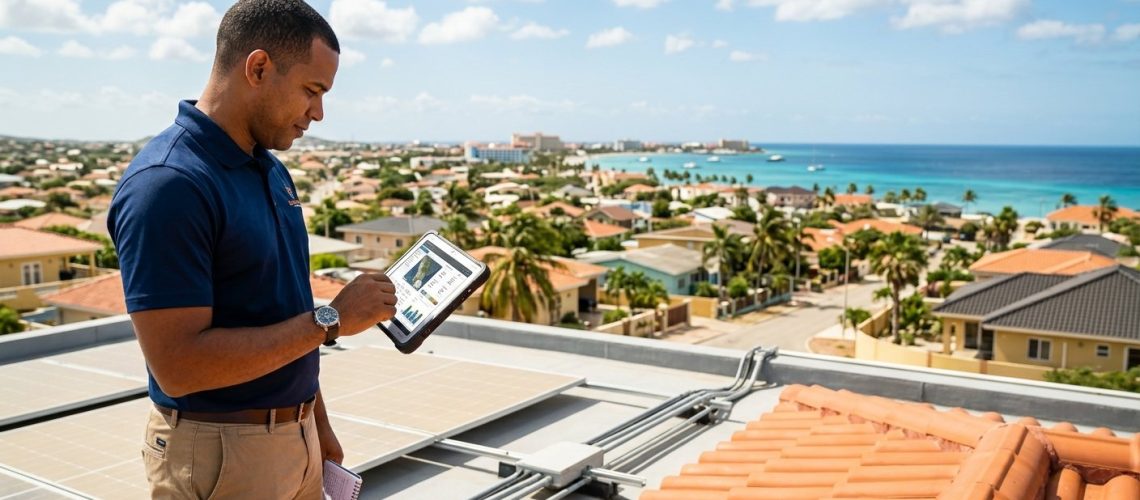
A solar site assessment evaluates:
- Roof orientation and tilt angle — south and west-facing roofs in Aruba typically capture the most effective solar radiation
- Shading analysis — nearby trees, structures, and rooftop equipment can reduce generation significantly if not accounted for
- Available roof area — directly determines how large a system can be installed
- Roof condition and material — concrete tile, metal, and flat roofs each have different mounting considerations in coastal tropical environments
This isn’t a generic calculation. It’s your property, analyzed with precision.
3. Recommended System Size
Based on your consumption data and roof assessment, the study identifies the optimal system size for your situation. Residential systems in Aruba commonly range from 5 to 15 kWp for households, while commercial properties and larger estates may require systems of 20 to 100+ kWp.
Getting sizing right is where community-focused solar solutions genuinely earn their value. An undersized system leaves money on the table. An oversized one may not align with local grid regulations or your actual load profile. The feasibility study finds that precise balance.
4. Financial Projections and ROI Timeline
One of the most eye-opening sections of any solar energy evaluation is the financial analysis. This section translates your solar potential into real numbers: estimated annual energy production, projected reduction in electricity costs, system payback period, and long-term savings over the system’s 25+ year lifespan.
For most Aruba homeowners and businesses, well-designed solar systems deliver a payback period in the range of 3 to 5 years—after which the energy your panels generate represents direct financial benefit to your household or bottom line. The International Renewable Energy Agency (IRENA) consistently highlights the Caribbean as a region where solar economics are particularly compelling, given high conventional electricity costs and abundant sun.
The financial projection also helps you evaluate financing options, incentive structures, and net metering arrangements where applicable—giving you a full picture rather than a single number.
5. Grid Connection and Net Metering Viability
In Aruba, connecting a solar system to the utility grid involves working within the framework established by WEB Aruba NV, the island’s energy provider. Your feasibility study will assess your property’s eligibility for grid-connected solar and outline how net metering—the process of sending excess energy back to the grid in exchange for credits—may apply to your situation.
For properties where grid independence is preferred or where grid access is limited, the assessment will also evaluate off-grid configurations, including battery storage. You can explore those solutions further through our off-grid solar power page.
6. Coastal and Environmental Considerations
Aruba’s coastal environment brings beautiful scenery and consistent trade winds—but also salt air exposure that affects solar equipment over time. A thorough solar site assessment for island properties accounts for:
- Salt-resistant mounting and racking materials
- Panel coating durability in high-UV, high-humidity conditions
- Inverter placement to minimize corrosion risk
- Long-term maintenance recommendations suited to the local environment
Caribbean solar energy specialists understand these nuances in ways that general assessments simply don’t capture. Local island expertise isn’t a marketing phrase—it’s the difference between a system that performs beautifully for decades and one that underperforms after a few salty seasons.
Residential vs. Commercial Assessments
While the core elements remain consistent, solar feasibility studies differ in scope depending on the property type.
Residential assessments focus on household consumption, roof space, and achieving the best possible reduction in monthly electricity costs for your family. They’re typically completed quickly and form the foundation for a tailored home solar system. Learn more about what this looks like through our residential solar systems page.
Commercial assessments are more complex, often involving three-phase power systems, peak demand analysis, operational schedules, and larger roof or ground-mount configurations. For businesses in Oranjestad managing significant energy costs, the ROI case is often even more compelling. Explore the commercial perspective on our commercial solar solutions page.
What Happens After the Study?
A solar feasibility study is a decision-making tool, not a commitment. After reviewing the findings, you have complete clarity to decide whether solar makes sense for your property, what size system aligns with your goals, and what your realistic financial outcome looks like.
If you move forward, the study’s findings directly inform your system design, permitting documentation, and installation planning. Everything is already tailored to your specific property—which means your installation proceeds efficiently and your system performs from day one as projected.
If the study reveals that now isn’t the right time—perhaps a roof replacement is needed first, or shading is more significant than anticipated—that’s equally valuable information. The goal is always your best outcome, not just a sale.
Frequently Asked Questions
How long does a solar feasibility study take?
For most residential properties in Oranjestad, the assessment process takes between one and three days from the initial site visit to receiving your full report. Commercial assessments with complex energy loads may take slightly longer to ensure accuracy.
Does a solar energy assessment cost anything?
B Energy offers initial solar consultations to help Aruba property owners understand their potential. Contact us directly to discuss the specifics of your property and what the assessment process involves for your situation.
Will my roof definitely support solar panels?
Most residential and commercial roofs in Aruba can support solar installations, but the feasibility study will confirm this based on structural condition, available area, and orientation. If modifications are needed, you’ll know that before making any investment decision.
What if my property has significant shading?
Shading doesn’t automatically disqualify a property from solar. Modern solar technology, including microinverters and optimized panel configurations, can significantly reduce the impact of partial shading. The assessment will model your specific shading scenario and recommend the most effective approach.
Can a feasibility study evaluate battery storage as well?
Yes. If energy independence or backup power during outages is important to you, the assessment will evaluate battery storage options alongside your solar system design, giving you a complete picture of what a fully integrated energy solution looks like for your property.
Your Property Has Potential—Let’s Discover It Together
A solar feasibility study is where energy transformation begins. It turns curiosity into confidence, uncertainty into clarity, and possibility into a concrete plan. For families and businesses in Oranjestad, it’s the first step toward lower electricity costs, greater energy security, and a meaningful contribution to a more sustainable Aruba.
As Caribbean solar energy specialists with deep local island expertise, B Energy is here to guide you through every step—starting with an honest, thorough assessment of what solar can genuinely do for your property.
Ready to find out what your property can do? Contact B Energy today to schedule your solar energy assessment in Aruba and take the first step toward your energy future.