
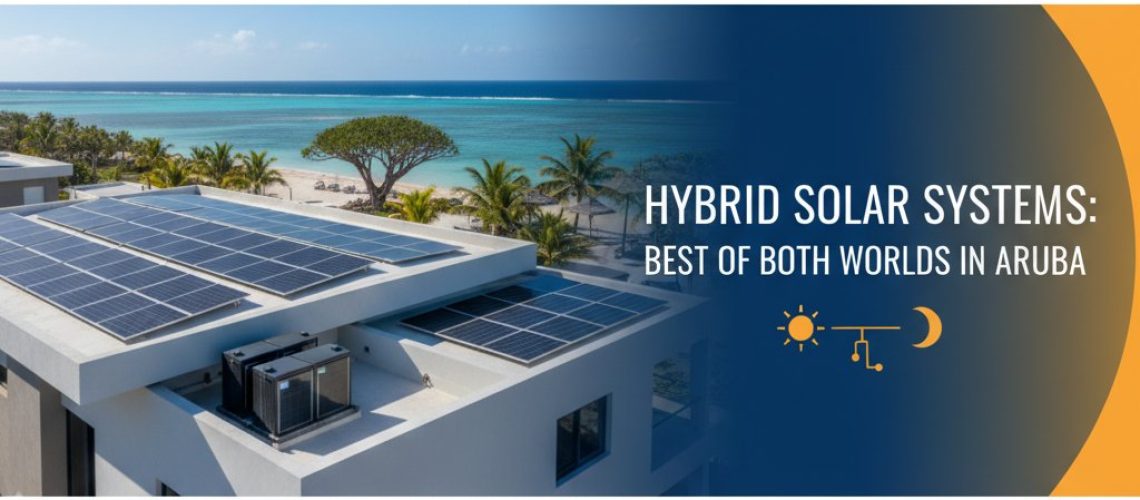
Imagine never worrying about power outages again while still enjoying the financial benefits of grid-connected solar energy. That’s the promise of hybrid solar systems, a technology that’s transforming how Aruba residents and businesses approach energy independence. Unlike traditional grid-tie systems that go dark during outages or off-grid systems that require expensive oversizing, hybrid solar systems aruba solutions deliver reliable backup power, grid connectivity, and maximum return on investment all in one elegant package.
As electricity costs continue challenging household and business budgets across the Caribbean, hybrid systems represent an intelligent middle path—combining the cost-effectiveness of grid-tied solar with the security of battery storage. For Aruba’s forward-thinking homeowners and business owners, this technology isn’t just about saving money; it’s about taking control of your energy future while contributing to our island’s sustainable development.
Understanding Hybrid Solar Technology
Hybrid solar systems integrate three essential components: solar panels, battery storage, and a sophisticated inverter that manages power flow between your solar array, batteries, utility grid, and your home or business. Think of it as an intelligent energy management system that automatically decides where your electricity comes from and where it goes based on your needs and priorities.
During sunny days, your solar panels generate electricity that powers your property immediately. Excess energy charges your battery bank first, then feeds back to the grid for credit through net metering programs. When the sun sets or clouds roll in, your system seamlessly draws from your batteries before tapping the utility grid. If a power outage occurs, your hybrid system instantly disconnects from the grid and runs your essential loads from solar and battery power—all without you lifting a finger.
This automatic switching capability distinguishes solar plus storage caribbean solutions from simpler systems. You’re not choosing between grid savings and energy security; you’re getting both benefits simultaneously.
Why Hybrid Systems Make Sense for Aruba
Aruba’s unique energy landscape makes hybrid solar systems particularly valuable. Our island enjoys abundant sunshine year-round, with solar panels producing consistent energy that can significantly offset electricity costs. However, grid stability concerns and the high value we place on reliable power make battery backup essential for many properties.
High Electricity Costs Meet High Solar Production
With electricity rates among the highest in the region, Aruban households and businesses face substantial monthly utility bills. A properly sized hybrid system can reduce your grid consumption by 70-90%, translating to significant monthly savings. For a typical Aruba home consuming 800-1,200 kWh monthly, a 7-10 kWp hybrid system with 10-15 kWh of battery storage typically delivers ROI within 3-5 years while providing backup security that pure grid-tie systems cannot match.
Commercial properties see even faster returns. A business with 3,000-5,000 kWh monthly consumption investing in a 25-40 kWp hybrid system with appropriate battery capacity often achieves payback in under four years, while eliminating costly downtime from power disruptions.
Energy Security Without Compromise
Traditional grid-tie battery systems shut down during outages for safety reasons, even when your panels are producing power and your batteries are charged. Hybrid systems eliminate this frustration through intelligent grid disconnection that keeps your critical loads running. Your refrigerator stays cold, your internet router remains online, and your business operations continue without expensive generator fuel or disruption.
This energy security proves invaluable for businesses that cannot afford downtime—from restaurants protecting inventory to offices maintaining productivity, from medical facilities ensuring patient care to retail operations processing transactions. The peace of mind alone justifies the modest additional investment over standard grid-tie systems.
Sizing Your Hybrid System for Maximum Benefit
Properly sizing a hybrid system requires balancing three factors: your average energy consumption, your critical backup needs, and your budget. Unlike off-grid systems that must cover 100% of your usage with significant oversizing, hybrid systems can be right-sized for optimal economics.
Residential System Sizing
For Aruba homes, we typically recommend systems ranging from 5-15 kWp solar capacity paired with 10-20 kWh battery storage. A conservative approach starts with 7 kWp solar and 10 kWh batteries, covering 60-80% of typical household consumption while providing 4-6 hours of backup power for essential loads like refrigeration, lighting, fans, and internet.
Larger homes or those seeking greater independence might install 12-15 kWp arrays with 15-20 kWh battery capacity, achieving 80-95% grid offset and 8-12 hours of backup runtime. The beauty of hybrid systems is scalability—you can start with a smaller battery bank and expand capacity later as budget allows or needs increase.
Commercial System Considerations
Businesses benefit from larger installations ranging from 20-100+ kWp depending on consumption patterns and facility size. A typical restaurant or retail shop might install a 25-35 kWp system with 30-50 kWh battery storage, while larger commercial facilities may deploy 50-100 kWp arrays with proportional battery capacity.
The key is analyzing your consumption profile to determine when you use power most heavily. Businesses with significant daytime usage maximize solar self-consumption naturally, while those with evening peaks benefit more from battery storage. A properly designed solar battery storage caribbean system aligns generation, storage, and consumption for optimal financial performance.
Battery Technology and Coastal Considerations
Battery selection significantly impacts system performance and longevity, especially in Aruba’s coastal environment. Modern lithium-ion batteries dominate the hybrid solar market for good reasons: higher efficiency, longer lifespan, deeper discharge capability, and compact size compared to older lead-acid technologies.
Lithium Battery Advantages
Quality lithium batteries deliver 10-15 years of service with 5,000-8,000 charge cycles at 80% depth of discharge. This means you can use more of your stored energy daily without degrading battery life. They also maintain consistent performance across wide temperature ranges—important for outdoor installations in tropical climates.
While lithium batteries carry higher upfront costs than lead-acid alternatives, their superior lifespan and usable capacity deliver better long-term value. When calculating true cost-per-kWh over system lifetime, lithium consistently wins for grid-tie battery systems.
Protecting Equipment in Salt Air
Aruba’s coastal environment requires special attention to equipment protection. Salt-laden air accelerates corrosion on electrical connections and enclosures. Reputable installers use marine-grade components, conformal coatings on circuit boards, and properly sealed enclosures rated for outdoor coastal use.
Battery and inverter placement matters significantly. Indoor installation in climate-controlled spaces extends equipment life considerably. When outdoor installation is necessary, proper enclosure selection and regular maintenance become critical. These considerations apply throughout the Caribbean—similar principles guide solar energy storage bonaire installations and battery backup solar curacao projects.
Smart Energy Management Features
Modern hybrid inverters include sophisticated energy management capabilities that optimize system performance automatically. Time-of-use programming lets you prioritize battery charging during low-rate periods and discharge during peak-rate times if your utility offers variable pricing. Some systems learn your consumption patterns and adjust battery management accordingly.
Mobile apps provide real-time monitoring of solar production, battery charge level, grid consumption, and household usage from anywhere. You can track your environmental impact—tons of CO2 avoided, equivalent trees planted—connecting your investment to tangible sustainability outcomes. This visibility helps you optimize energy use patterns and maximize savings.
Advanced systems support load prioritization, automatically managing which circuits receive power during battery operation. Your refrigerator and internet stay online while less critical loads like pool pumps or water heaters temporarily shut down, extending backup runtime intelligently.
Financial Performance and Incentives
The financial case for hybrid systems in Aruba is compelling when analyzed over system lifetime. While initial investment exceeds basic grid-tie installations by 30-50% due to battery costs, the added value justifies the premium for most property owners.
Consider a typical scenario: a household spending $250-350 monthly on electricity installs a $15,000-18,000 hybrid system. Monthly savings of $200-280 deliver payback in 4-5 years, after which the system generates essentially free electricity for another 15-20 years. Over 25 years, total savings often exceed $60,000-80,000 compared to continued grid dependence—a remarkable return on investment.
Businesses with higher consumption see even more dramatic returns. A commercial property spending $1,500-2,000 monthly on electricity might invest $50,000-70,000 in a properly sized hybrid system, achieving payback in 3-4 years while eliminating business disruption costs from outages.
Check with local authorities about available incentives, tax credits, or accelerated depreciation for commercial installations. Even without incentives, the economics remain attractive, but available programs improve returns further.
Installation and Maintenance Requirements
Professional installation is essential for hybrid system performance and safety. Qualified installers properly size components, ensure code compliance, configure battery management parameters correctly, and test backup operation thoroughly. While DIY solar might work for simple systems, hybrid installations involve complex electrical work and sophisticated programming that require professional expertise.
Maintenance requirements remain minimal but important. Annual inspections should verify electrical connections remain tight and corrosion-free, solar panels are clean and unshaded, battery performance meets specifications, and inverter firmware stays current. Many installers offer maintenance packages that handle these tasks while monitoring system performance remotely.
Battery replacement represents the major long-term maintenance expense. Plan for battery replacement around year 10-12, with costs partially offset by continued savings. By replacement time, battery prices typically have declined while capacities have improved, making upgrades attractive.
Contributing to Aruba’s Sustainable Future
Every hybrid solar system installed in Aruba contributes to our island’s energy independence and environmental goals. By reducing grid demand, distributed solar generation decreases fossil fuel consumption at central power plants, lowering emissions and improving air quality we all breathe.
Your investment demonstrates community leadership—showing neighbors and fellow business owners that energy independence is achievable and financially smart. As more properties adopt solar plus storage caribbean technology, we collectively build a more resilient, sustainable energy infrastructure that benefits everyone.
The ripple effects extend beyond your property. Local installation jobs support island families. Reduced electricity costs free household income for other priorities. Businesses operate more competitively with lower overhead. Our island becomes more attractive to environmentally conscious visitors and investors who value sustainability.
Making Your Hybrid Solar Decision
Choosing a hybrid solar system represents a commitment to energy independence, financial savings, and environmental stewardship. Start by evaluating your electricity bills from the past year to understand consumption patterns. Consider which loads you must power during outages versus those that can temporarily go offline. Think about your long-term plans—will your property see increased consumption from electric vehicles, expanding business operations, or growing families?
Consult with experienced local installers who understand Aruba’s specific conditions and requirements. Request multiple quotes that clearly detail system sizing, equipment specifications, expected production, warranty terms, and projected savings. Verify installer credentials, check references, and review previous installations when possible.
The best time to invest in hybrid solar is now. Every month you delay represents continued high electricity expenses and missed savings opportunities. Equipment costs have stabilized while technology continues improving. Financing options make systems accessible to more property owners than ever before.
Ready to take control of your energy future? Connect with qualified solar installers serving Aruba to discuss hybrid systems tailored to your specific needs. Join the growing community of island residents and businesses enjoying lower electricity costs, enhanced energy security, and the satisfaction of contributing to a more sustainable Caribbean. Your hybrid solar system isn’t just an investment in your property—it’s an investment in Aruba’s bright, clean energy future.