Electricity in Aruba costs significantly more than in many parts of the world—and for homeowners and business owners tired of watching their bills climb month after month, off-grid solar offers a genuinely life-changing alternative. But before you take the leap, it helps to understand exactly what makes a complete off-grid solar system work. This isn’t just about slapping panels on a roof. A well-designed standalone solar system is an engineered ecosystem of components, each playing a critical role in delivering reliable, clean power every single day.
Whether you’re powering a family home in Oranjestad or a small commercial operation, understanding the building blocks of off-grid solar will help you ask smarter questions, make informed decisions, and ultimately invest with confidence. Let’s walk through what you really need.
What Makes Off-Grid Solar Different?
Off-grid solar systems operate completely independently from the utility grid. There’s no backup from Elmar when clouds roll in or when demand spikes. That independence is exactly what makes off-grid solar so powerful—and why the system design matters so much.
Unlike a simple grid-tied setup that exports excess energy to the utility, a complete off-grid solar system must generate, store, and manage all the energy your property consumes. Every component must be sized correctly and work seamlessly together. Miss one piece of the puzzle, and your system underperforms when you need it most.
For a deeper look at the lifestyle and benefits side of going fully independent, explore our dedicated off-grid solar power resource.
The Core Off-Grid Solar Components
1. Solar Panels (PV Modules)
Solar panels are the heart of any off-grid solar system. They convert Aruba’s abundant sunlight into direct current (DC) electricity. For residential off-grid solar in the Caribbean, systems typically range from 5 kWp to 30 kWp, while commercial installations can reach 100 kWp or more.
When choosing panels for Aruba’s environment, a few things matter beyond raw wattage:
- Salt air resistance: Coastal environments accelerate corrosion. Look for panels with marine-grade frames and robust encapsulation that protect against humidity and salt exposure.
- High-temperature performance: Panels lose some efficiency as temperatures rise. Quality panels with low temperature coefficients perform better in tropical heat.
- Durability ratings: Industry certifications like IEC 61215 and IEC 61730 indicate that panels have been tested against impact, moisture, and environmental stress—important for island conditions.
Panel quantity is determined by your daily energy consumption, the hours of peak sunlight available (Aruba averages excellent solar irradiance year-round), and how much energy buffer your system needs.
2. Battery Bank: Your Energy Reserve
Batteries are what truly make off-grid solar work. They store surplus energy generated during daylight hours so you have power at night, on overcast days, and during periods of high demand.
Choosing the right battery bank is arguably the most important decision in your off-grid solar design. The two dominant technologies in 2026 are:
- Lithium Iron Phosphate (LiFePO4): The current gold standard for off-grid Caribbean applications. These batteries offer deep discharge capability (typically 80-100% usable capacity), long cycle life (3,000–6,000+ cycles), minimal maintenance, and excellent performance in warm climates. They’re more expensive upfront but deliver superior long-term value.
- Flooded Lead-Acid / AGM: Lower initial cost, but heavier, shorter lifespan, and less efficient in high-heat environments. They require more careful maintenance and offer less usable capacity per unit of storage.
Battery bank sizing is calculated by multiplying your daily energy consumption (in kilowatt-hours) by the number of “autonomy days” you want—typically two to three days of independence without sun. This ensures your home or business stays powered through anything short of an extended overcast stretch.
3. Charge Controller
The charge controller sits between your solar panels and your battery bank. Its job is to regulate the voltage and current flowing from the panels into the batteries, preventing overcharging (which degrades batteries) and over-discharging (which can damage them permanently).
There are two main types:
- PWM (Pulse Width Modulation): Simpler and more affordable, suitable for smaller, budget-conscious systems.
- MPPT (Maximum Power Point Tracking): More sophisticated and significantly more efficient—typically 15-30% more energy harvest compared to PWM. For most properly sized off-grid solar Caribbean installations, MPPT is the recommended standard.
According to the National Renewable Energy Laboratory, MPPT charge controllers consistently outperform PWM in high-irradiance tropical environments, making them well worth the investment for island off-grid systems.
4. Inverter: Converting Power for Your Home
Your appliances run on alternating current (AC). Your solar panels and batteries produce direct current (DC). The inverter bridges that gap, converting stored DC energy into the AC electricity that powers your refrigerator, air conditioning, lighting, and every other device in your home or business.
For off-grid solar design, the two most relevant inverter types are:
- Pure sine wave inverters: Produce clean, utility-grade electricity suitable for all appliances, including sensitive electronics, modern air conditioners, and variable-speed motors. This is the only type worth considering for a complete off-grid system.
- Hybrid/multi-mode inverters: Combine inverter, charger, and sometimes MPPT charge controller functions into a single unit, simplifying installation and reducing points of failure. These are increasingly popular in 2026 and work exceptionally well in tropical off-grid solar Caribbean applications.
Inverter sizing must account for your peak load—the maximum power draw when multiple appliances run simultaneously—not just your average consumption. Undersizing an inverter is one of the most common and costly off-grid solar design mistakes.
5. Mounting Structure and Wiring
The hardware holding your panels in place is more than a supporting role. Mounting systems for coastal Aruba installations must resist salt corrosion and withstand strong trade winds. Aluminum and marine-grade stainless steel are the materials of choice.
Proper wiring—including correctly sized cables, weatherproof conduit, and appropriate circuit protection (fuses and breakers)—is essential for both safety and system efficiency. Undersized wiring causes resistive losses; incorrectly protected circuits create safety hazards. A professionally engineered wiring plan is non-negotiable for any standalone solar system.
6. Monitoring System
A quality monitoring system lets you see your solar generation, battery state-of-charge, and energy consumption in real time—often from your smartphone. Beyond the satisfaction of watching your panels produce clean energy, monitoring helps you catch performance issues early, adjust usage habits, and get the most from your investment.
Many modern hybrid inverters include built-in monitoring with cloud connectivity, making this component increasingly integrated rather than separate.
How Off-Grid Solar Components Work Together
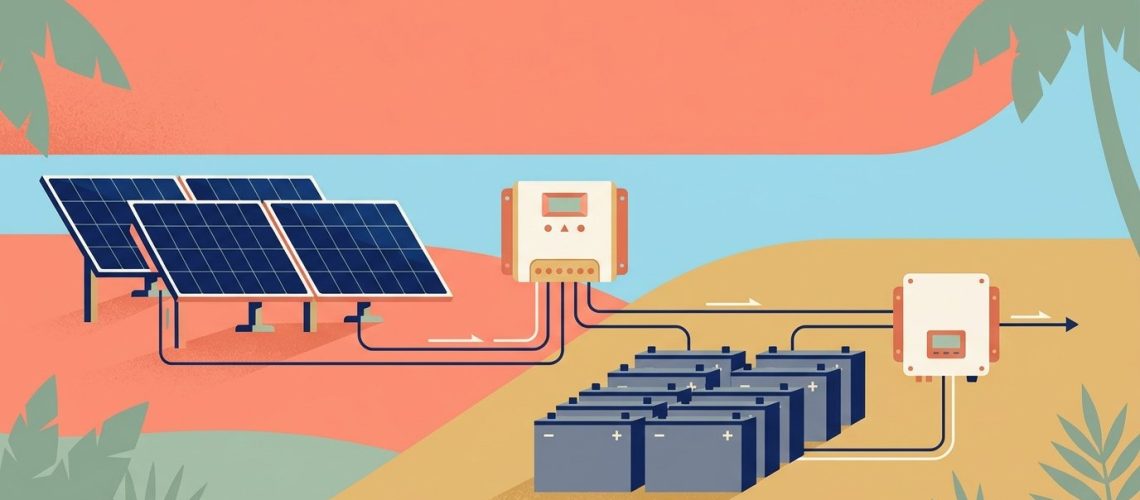
Imagine a typical Oranjestad afternoon: your solar panels are generating peak power under full sun. The MPPT charge controller maximizes energy harvest and routes it to your battery bank, topping off your reserves. Meanwhile, your hybrid inverter simultaneously powers your home’s loads from the panels directly, reducing battery draw. By sunset, your batteries are full—ready to carry you through the night.
This coordinated flow is the elegance of a well-designed off-grid system. Each component depends on the others being properly sized and matched. That’s why off-grid solar design is both a science and a craft—and why working with Caribbean solar energy specialists who understand local conditions makes such a meaningful difference.
If you’re exploring options for your home specifically, our residential solar systems page covers how these principles translate to practical home solutions. Business owners can find tailored guidance through our commercial solar solutions.
The Real ROI of a Complete Off-Grid Solar System
A complete off-grid solar investment in Aruba typically delivers payback within 3 to 5 years, depending on system size, energy consumption, and current utility spending. After that window, you’re generating free energy from the sun for 20-25+ years. According to IRENA (International Renewable Energy Agency), solar PV costs have continued falling globally, making the economics of off-grid solar more compelling than ever in 2026—particularly for island communities where grid electricity remains expensive.
Beyond the numbers, energy independence means freedom from utility price increases, protection from grid outages, and the quiet pride of powering your life sustainably.
Frequently Asked Questions
How much does a complete off-grid solar system cost in Aruba?
Costs vary based on system size, battery technology, and your property’s energy needs. Residential systems typically range from smaller 5 kWp setups to larger 30+ kWp installations. A professional assessment of your consumption is the essential first step to accurate pricing. Most systems deliver payback within 3–5 years given Aruba’s electricity rates.
How many solar panels do I need for off-grid living?
Panel quantity depends on your daily kilowatt-hour consumption, Aruba’s solar irradiance, and your desired energy buffer. A professional off-grid solar design will calculate this precisely—guessing leads to undersized or oversized systems that cost you in different ways.
What’s the best battery for off-grid solar in tropical climates?
Lithium Iron Phosphate (LiFePO4) batteries are the top choice for Caribbean off-grid applications. They handle heat well, offer deep usable capacity, require minimal maintenance, and have long cycle life—making them the most cost-effective option over the lifetime of your system.
Can a standalone solar system power air conditioning?
Yes. With correct system sizing—accounting for the higher startup and running loads of air conditioning units—a standalone solar system can power AC reliably. This is a common and achievable goal for Aruba households and businesses.
Do off-grid solar systems require a lot of maintenance?
Modern off-grid systems are designed for low maintenance. Panels benefit from periodic cleaning (Aruba’s trade winds help, but dust accumulates), and battery systems should be monitored and inspected periodically. Lithium batteries require far less hands-on care than older lead-acid alternatives.
Take the First Step Toward Energy Independence
Understanding off-grid solar components is empowering—because it transforms solar from a mysterious technology into a clear, logical system you can trust. The right panels, batteries, charge controller, inverter, and supporting hardware, designed specifically for Aruba’s environment and your energy needs, create something remarkable: a home or business that runs on sunlight.
At B Energy, we believe every Oranjestad family and business deserves that freedom. Our community-focused solar solutions combine local island expertise with proven off-grid solar design to deliver systems built for the Caribbean—not retrofitted from somewhere else.
Ready to explore what a complete off-grid solar system looks like for your property? Contact B Energy today for a personalized assessment, and let’s start building your path to true energy independence—one component at a time.