

Comparing solar quotes in Aruba means evaluating more than price — you need to assess system size, equipment quality, warranty terms, installer credentials, and realistic ROI projections together. A lower upfront quote can cost more over time if the panels underperform or the installer lacks local expertise. This guide walks Aruba homeowners through every step so you can choose with confidence.
- Never compare quotes on price alone — system size (kWp) and equipment quality determine real value.
- Warranties matter enormously: look for 25-year panel performance guarantees and at least 10-year workmanship coverage.
- A credible installer will size your system to your actual energy consumption, not a generic estimate.
- B Energy typically quotes a 3–5 year payback for residential systems in Aruba.
- Ask every installer for a written ROI projection and verify it against your own bills.
Why Getting Multiple Quotes Is Worth the Effort
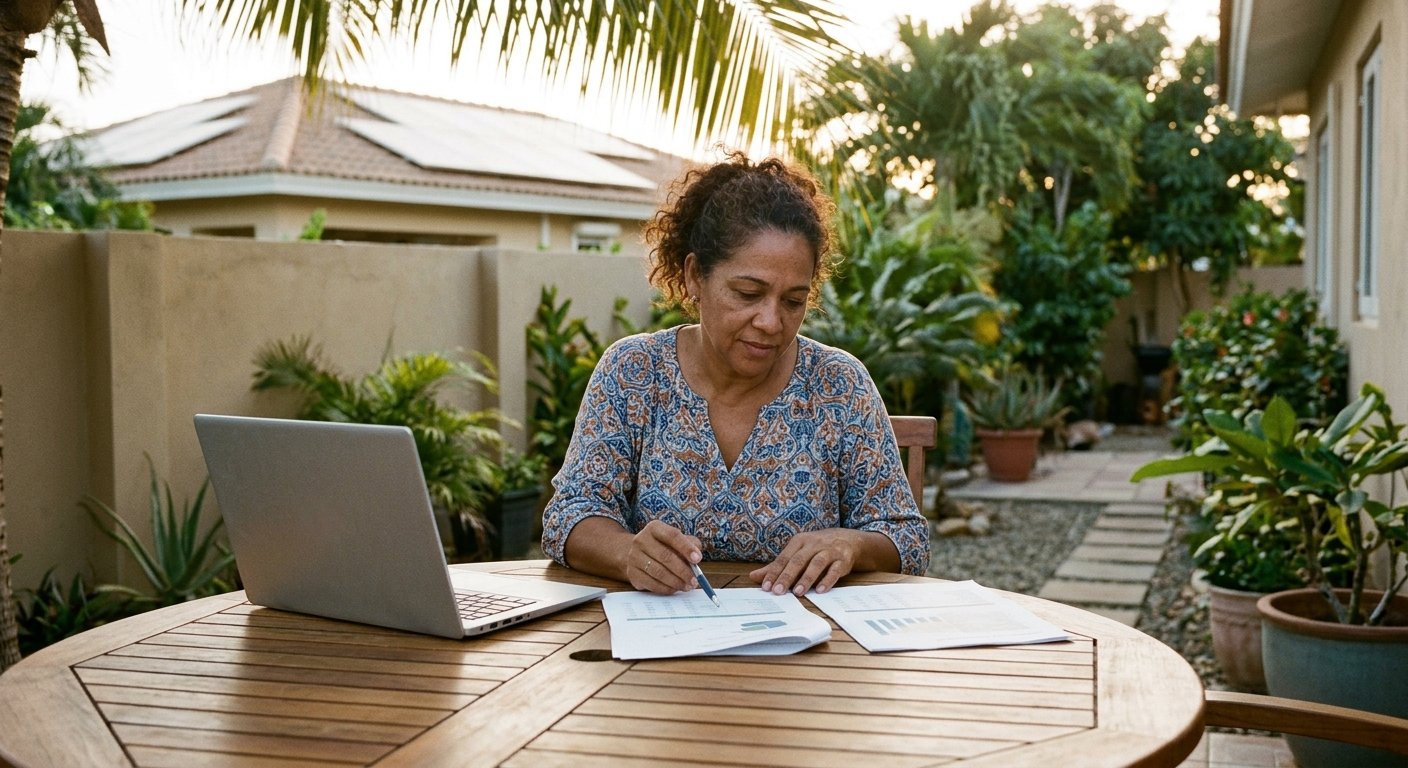
Going solar is one of the most meaningful investments an Aruba homeowner can make — financially and for the community. But the solar market has matured, and quotes can vary widely in what they actually include. Two proposals that look similar on the surface may differ in panel efficiency, inverter technology, mounting hardware, and post-installation support. Taking time to compare them side by side is the difference between an investment that pays back in 3–5 years and one that underdelivers for a decade.
If you’re still exploring whether solar makes sense for your home financially, the Solar Energy Savings Calculator for the ABC Islands is a helpful starting point before you request a single quote.
Request at least three quotes. This gives you a meaningful range and reveals whether any single installer is outlying on price, system size, or promises. If one quote is dramatically cheaper, dig into why — it almost always reflects a difference in equipment grade or warranty terms.
Step 1: Understand What You’re Actually Being Quoted

Before you can compare quotes fairly, you need to know what each one includes. A complete residential solar quote should specify the following:
- System size in kilowatt-peak (kWp): For most Caribbean family homes, systems range from 5 to 15 kWp. Commercial systems can reach 100+ kWp. A system sized too small won’t offset enough of your bill; oversized systems may not be approved by the local utility.
- Panel brand, model, and efficiency rating: Higher efficiency panels generate more energy per square meter — important on a roof with limited space.
- Inverter type: String inverters are common and cost-effective; microinverters offer panel-level monitoring and better performance in partial shade.
- Mounting and racking system: In Aruba’s coastal environment, corrosion-resistant hardware is non-negotiable.
- Installation labor, permits, and grid connection: These should be included in any honest quote, not added later as surprises.
Collect all quotes in writing
Verbal estimates don’t count. Ask every installer to provide a written proposal with itemized equipment specs, labor, and warranty terms before you compare anything.
Normalize by system size
Divide the total price by the system’s kWp rating to get a cost-per-kWp figure. This makes apples-to-apples comparison possible when proposals suggest different system sizes.
Verify equipment independently
Look up the panel model on the manufacturer’s data sheet. Reputable manufacturers like SunPower, Jinko Solar, and LONGi publish verified efficiency and degradation specs publicly.
Evaluate warranties separately from equipment
The product warranty (covering defects) and performance warranty (guaranteeing output over time) are different documents. Read both and confirm who honors the warranty if the installer closes.
Ask for a site-specific ROI projection
A credible installer will base their payback estimate on your actual electricity bills and your roof’s orientation — not a generic island average.
Step 2: Evaluate Warranties Like a Pro

Warranties are where solar quotes most commonly hide meaningful differences. There are three types to review.
Panel Product Warranty
This covers manufacturing defects. Industry-standard coverage is 10–12 years, though premium manufacturers offer 25 years. Shorter coverage on a panel that costs less upfront is rarely the bargain it appears.
Panel Performance Warranty
Solar panels degrade slowly over time. A strong performance warranty guarantees that after 25 years, the panel will still produce at least 80–87% of its original rated output. According to the National Renewable Energy Laboratory (NREL), median panel degradation rates in the industry run around 0.5% per year — meaning a well-specified system retains strong output well into its third decade. Verify what percentage each proposal guarantees at year 25.
Workmanship (Installer) Warranty
This covers the installation itself — wiring, mounting, waterproofing. A minimum of 5 years is standard; 10 years signals genuine confidence in the work. In Aruba’s salt-air coastal environment, quality installation matters as much as quality equipment. You can read more about why Caribbean solar installations require different standards than mainland systems to understand why this distinction is so important here.
| Warranty Type | Minimum Acceptable | Best Practice |
|---|---|---|
| Panel product | 10 years | 25 years |
| Panel performance | 80% output at year 25 | 87%+ output at year 25 |
| Workmanship | 5 years | 10 years |
| Inverter | 5 years | 10–12 years |
Step 3: Assess Installer Credentials and Local Experience
Equipment quality means little if the installation is done poorly. In Aruba, where the combination of salt air, intense sun, and periodic heavy rainfall creates demanding conditions, you want Caribbean solar energy specialists — not installers learning tropical conditions on your roof.
Ask every installer these questions directly:
- How many residential systems have you installed in Aruba specifically?
- Are you registered and compliant with local utility and permitting requirements?
- Who handles post-installation service and monitoring?
- Can you provide references from island homeowners (not just online reviews)?
A company with genuine local island expertise will answer these questions fluently and specifically. Vague or generic answers — especially about permits and utility connection — are a warning sign worth taking seriously.
Aruba’s grid connection process is governed by WEB Aruba, the island’s utility. Any installer working here should be thoroughly familiar with WEB’s current net-metering policies and technical requirements. If an installer seems uncertain about local utility rules, that uncertainty will show up in your installation timeline and paperwork.
Step 4: Read the ROI Projections Critically
Every solar quote should include an ROI or payback projection. B Energy typically quotes a 3–5 year payback for residential systems in Aruba, based on actual system sizing and local electricity rates. But how an installer calculates that figure matters as much as the number itself.
A credible projection will be grounded in your specific monthly consumption (from your actual bills), Aruba’s current residential electricity tariff from WEB Aruba, your roof’s orientation and available area, and realistic panel production estimates for Aruba’s solar irradiance levels.
A suspicious projection uses round numbers, doesn’t reference your bills at all, or promises payback timelines that seem implausibly fast without explanation. For a deeper look at what savings realistically look like on the island, the article what homeowners often miss about solar savings in Aruba covers the nuances that most sales conversations skip.
The best solar quote isn’t the cheapest one — it’s the one built on honest numbers and local knowledge.
Step 5: Compare the Full Picture, Not Just the Price
Once you have standardized quotes covering the same system size, you can evaluate total value. Consider: Which installer has a demonstrated track record specifically in Aruba? Which warranty package protects you longest? Which company provides ongoing monitoring and service after installation day? Who gave you a site-specific ROI projection versus a generic one?
For homeowners considering going fully off-grid — particularly those in areas with unreliable utility supply — the off-grid solar design options for Aruba homes page outlines what a battery-backed system looks like and when it makes sense.
Frequently Asked Questions
How many solar quotes should I get in Aruba?
Getting at least three quotes is the standard recommendation. This gives you a realistic price range, reveals outliers, and lets you compare equipment specs and warranty terms across multiple proposals. It also signals to installers that you’re an informed buyer, which tends to produce more careful, detailed proposals.
What system size do I need for a typical Aruba home?
System sizing depends on your actual electricity consumption, not a generic average. A qualified installer will ask for 3–6 months of your WEB Aruba bills and use that data to recommend the right kWp. For most Caribbean family homes, systems between 5 and 15 kWp are typical, though the right size for your household could fall anywhere in that range.
What is a realistic solar payback period in Aruba?
B Energy typically quotes a 3–5 year payback for residential solar systems in Aruba. The actual figure depends on your current electricity consumption, your system size, and how well the system is optimized for your roof. Be cautious of any proposal claiming payback under 2 years without a detailed, site-specific calculation to support it.
What warranties should a home solar installation in Aruba include?
A complete installation should include a panel product warranty (ideally 25 years), a panel performance warranty guaranteeing at least 80% output at year 25, an inverter warranty of at least 5–10 years, and a workmanship warranty from the installer covering at minimum 5 years. In Aruba’s coastal environment, workmanship quality and warranty length are especially important.
Can I connect a home solar system to Aruba’s grid?
Yes. WEB Aruba has a net-metering framework that allows grid-connected residential solar systems. Your installer must handle the application and technical compliance process. An experienced local installer will manage this as a standard part of the project; it should not be an afterthought or an added fee late in the process.
Ready for a solar consultation built around your home?
B Energy’s Caribbean solar energy specialists will assess your roof, review your bills, and provide a clear, honest quote — no generic estimates, no pressure.

About B Energy
B Energy is a mission-driven solar energy company serving Caribbean homeowners and businesses in Aruba and surrounding islands. We specialize in designing and installing residential and commercial solar systems (5-100+ kWp) optimized for tropical climates, coastal environments, and hurricane resilience. Our community-focused approach combines a typical 3-5 year payback, energy independence solutions, and environmental stewardship, empowering island residents to lower electricity costs while contributing to a sustainable Caribbean future. Visit b-energy.life →